Saying Goodbye to a Dying Pet: How to Spend the Last Days
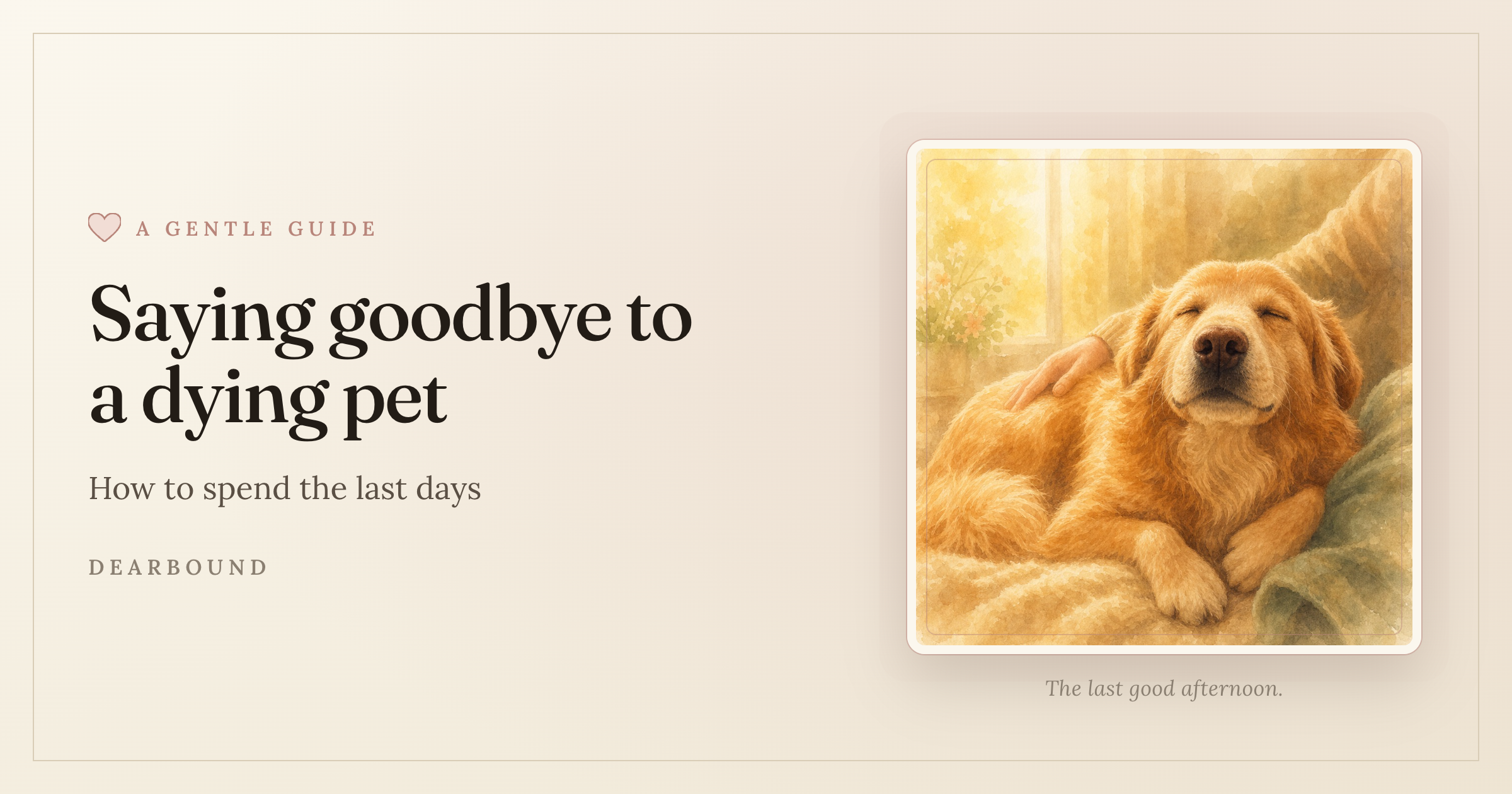
Somewhere in the last few days, the question changed.
It stopped being how do we get them better and became how do we do this well. Nobody hands you the second question. It arrives one afternoon, usually after a phone call, and then it sits down at the kitchen table with you.
If you are dreading something that hasn't happened yet — already grieving an animal who is asleep on the floor beside you right now, breathing — you are not doing this wrong. That's what this part is. This page is for that window: the last days, the decision if it's yours to make, and the goodbye itself.
If your pet is simply getting older and nothing is urgent, this isn't your page yet. The gentler read is making the most of time with a senior pet — stay in that window while you're in it.
Grieving before they've died has a name
It's called anticipatory grief, and it's exactly as strange as it feels. Crying in the car outside the vet's and then walking in composed. Watching their ribs from across the room to check they're still moving. Feeling guilty for catching yourself thinking about the after. Flinching at the word "still."
It doesn't need treating, and it isn't a sign you're falling apart ahead of schedule. It's what love does when it can see the end of something.
It comes with a strange side effect, too, and this is the part worth knowing: you notice everything. Their weight against your leg. The sound of their feet on the floor. The particular sigh when they finally settle. Most of us spend years half-looking at our animals, and you are not doing that this week.
That noticing is worth something. The rest of this page is mostly about how to spend it.
The decision, if it's yours to make
We can't tell you when. Nobody on the internet can, and anyone offering you a number or a chart that decides it for you is guessing about an animal they have never met.
The person who can genuinely help you think it through is your vet. They've seen your pet's bloodwork, and they've seen a great many other animals arrive at this same point. Two things are worth knowing about that conversation.
Ask for a quality-of-life assessment. Many vets will sit down and walk you through one if you ask — and many won't offer it unprompted, because they're waiting to follow your lead. You're allowed to ask for it directly.
Ask them, "if this were your dog, what would you do?" Put that way, most vets will answer you honestly. Asked any other way, they tend to stay carefully neutral, because they don't want to be the one who decided. That one sentence gives them permission.
Between appointments, there's a way of seeing more clearly that vets commonly suggest, and it isn't a scale of ours. Write down the handful of things your pet loves most — eating, greeting you at the door, getting up on their own, being comfortable, being themselves — and then watch, over a week or two, how many of them they still have. You aren't waiting for that list to reach zero. You're looking at whether the good days still outnumber the hard ones, and which way it's moving.
Two more things worth knowing now rather than later:
Choosing a day early is not the same as choosing it sooner. Deciding while you can still think — at home, in daylight, with the people who love them — is a kindness to both of you. Deciding at two in the morning in an emergency room, under fluorescent light, is the version people describe regretting for years.
There are more options than you may have been offered. Euthanasia at home is a real thing in many places, and some people badly want the last moment to happen on the living-room rug rather than on a steel table. Veterinary palliative and hospice care exists too — keeping a pet comfortable rather than treating them. Both are worth asking about, and neither tends to be offered if you don't ask.
And if this goes another way — if they die at home one night, without an appointment, before any of it is settled — that does not make you a worse owner. There is no version of this you can fail at by loving them the whole way through.
How to spend the days you have
This is where most guides reach for a bucket list, and it's the wrong instinct. A road trip is for you. What you have is a small amount of time and an animal with less in the tank than they had a month ago, so the goal isn't experience. It's comfort, and being together while it happens.
Go small, not big
A car ride with the window down. Ten minutes on the trail you've always walked, turning back early. The sunny patch on the carpet. The couch they were never allowed on, now theirs. Something good, hand-fed, slowly.
If they're tired, the answer is the floor beside them, not an outing. Lying on the rug with your hand on their side is not a lesser version of this. It may be the whole thing.
Let the rules go, within reason
The good food. The bed. The bad habit you spent two years training out of them. Ask your vet what's actually safe to give — some things genuinely aren't, and a bad night is a real cost — and then stop negotiating with yourself about it. You're not undoing their training. There's nothing left to protect it for.
Call the people who loved them
The neighbour who slipped them biscuits. The friend who looked after them every summer. Their grandparent, the one who claims not to be a dog person. Let them come by and say goodbye.
It's a gift to them — people are rarely offered the chance, and often carry it badly when they aren't — and it will tell you something to watch how many of them turn up for your animal.
Take the photos and video you'll want later
This is the concrete, time-sensitive one, and the thing people most often wish they'd done. Not more pictures. A few specific ones:
- Their paws.
- Your hand resting on them.
- A video of them walking, whatever walking looks like now.
- A video with their sound in it — the sigh, the snore, the noise they make at the door.
- A paw print, in clay or ink. Many vets will do one, and will do one afterwards if you ask.
- And the one almost nobody has: ask someone else to photograph the two of you together. Your camera roll is full of them and empty of you both.
Say it out loud to them
You don't have to save it for the last day. Say the thank-you now, in the kitchen, at an ordinary hour, while they're still awake enough to lean into you for it. Tell them what they've been to you. Tell them about the bad year they carried you through without ever knowing they were doing it.
It feels foolish for about four seconds, and then it doesn't.
Make something while they're still here
One of the things people say afterwards is that they wish they'd made something while the book could still sit on the floor next to the actual animal. If that's your instinct too, While You're Still Here ($32) is what we make for it: an 8-page personalized keepsake written entirely in the present tense — a celebration of your pet and your bond now, not a goodbye — and its own description is written for "a senior companion, or one facing a hard diagnosis." Its seven illustrations are each painted from a photo you upload — their real coat, their real grey muzzle, their real face — and then finished by hand, so the animal on the page is your animal. It arrives as a digital, print-ready PDF, hand-finished within 24–48 hours. If it isn't for you, the photographs and the paw print above are the same idea and cost nothing at all.
If there are children in the house
Tell them the truth, and tell them beforehand rather than after. A child who is surprised by this grieves the surprise as well as the pet.
Use the real words — dying, and then died. Not asleep, not gone away. Children take euphemisms literally, and "asleep" is a word they need to keep for bedtime.
Let them decide whether to be there, and give them an honest, plain description of what they would see, so it's a real choice rather than a brave one. Some children want to be in the room and manage it better than the adults do. Some would rather say goodbye at home, on the floor, that morning — and that is a complete goodbye.
Then let them do it their own way: a drawing, a letter, a favourite toy left in the bed, ten quiet minutes sitting with them. We wrote a fuller guide on helping a child cope with pet loss, including what to expect at different ages.
If there are other pets in the house
Some people let a surviving animal be in the room, or let them see the body afterwards, and many say it seemed to help. Honestly: we don't know what animals understand about death, and we're not going to pretend we do. If it feels right for your household, it's allowed. It isn't a requirement, and skipping it isn't a mistake.
What is fair to say is this. Expect the one who's left to be different for a while — off their food, searching the house, sitting in the wrong room, louder than usual, or closer to you than they've ever been. Keep their routine steady while yours falls apart: same walk, same times, same bowl. It's the one thing you can hand them that costs nothing.
Preparing for the appointment
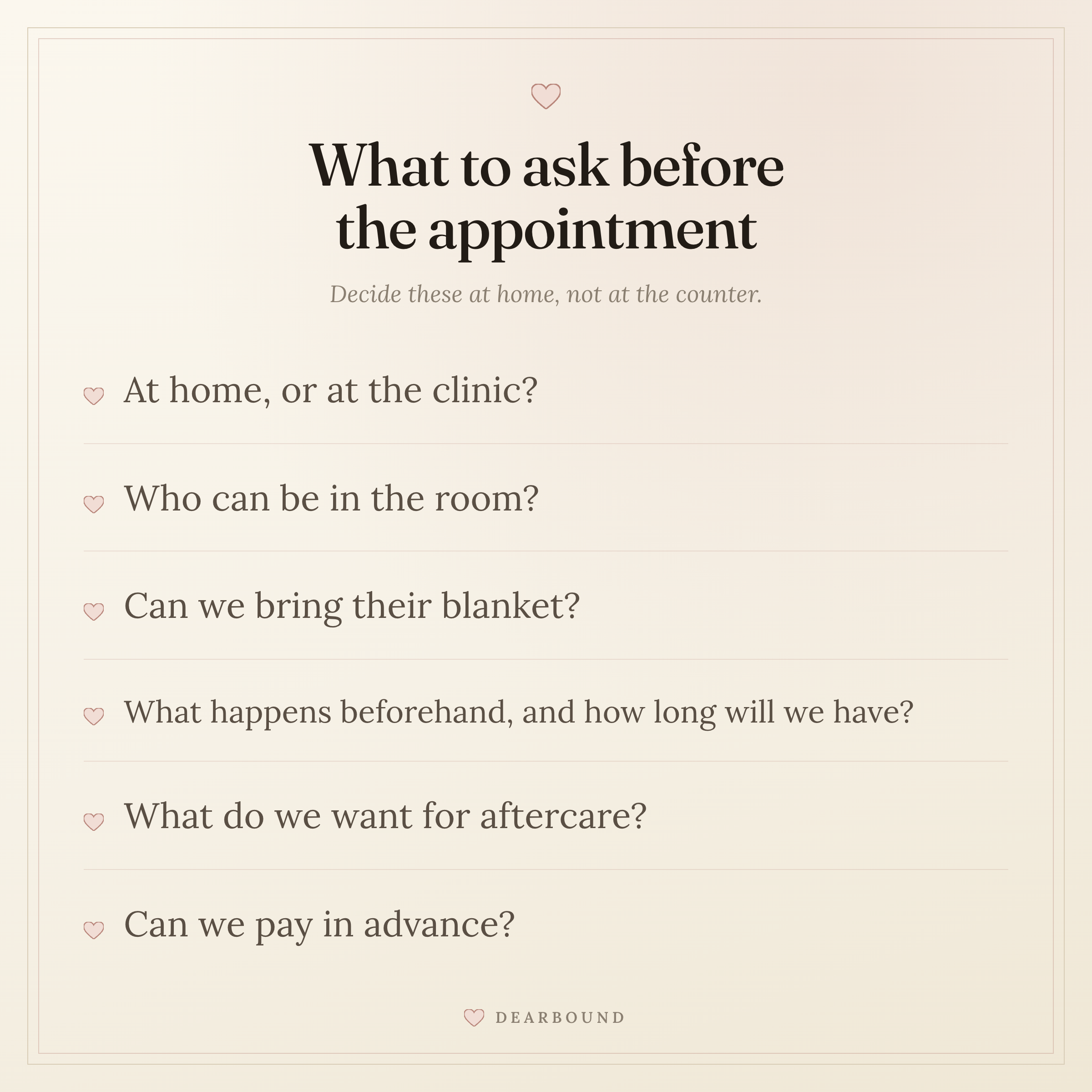
Most of what makes this hour bearable gets decided beforehand. Settle these in advance and you won't be choosing them in the worst ten minutes of your week, at a desk, with your pet in your arms.
- At home, or at the clinic? Both are fine. At home is calmer for a pet who finds the clinic frightening; the clinic is sometimes simpler, and sooner. Ask what's available near you.
- Can we have the quietest appointment of the day? The first or the last slot usually means an empty waiting room and no rush behind you.
- Who can be in the room? Ask how many people, and whether a child can be there. Most practices are more accommodating than people expect.
- Can we bring their blanket? The blanket, the bed, the toy. Their own smell is worth more to them than anything in the building.
- What happens beforehand, and how long will we have? You don't need the clinical detail — just the shape of the hour, so that nothing lands as a surprise, and so you know roughly how much time you'll have with them before and after.
- What do we want for aftercare? Burial where it's permitted, communal cremation, or private cremation; whether you want the ashes back; whether you'd like a paw print or a clipping of fur. Deciding this in the room is genuinely hard. Decide it at home.
- Can we pay in advance? Many practices will let you. It means you can leave straight afterwards instead of standing at a counter signing things.
- Who is driving us home? Ask someone. Don't plan to drive yourself.
Whether to be in the room
This gets asked more than almost anything else here, and there is no wrong answer to it.
Most people who stay are glad they stayed, and would do it again. It is a quieter, more ordinary thing than people brace for: you sit on the floor, you keep your hand on them, you talk to them.
And some people genuinely cannot, and being in the corridor is not a betrayal. Your pet has had your whole presence for years; the last ten minutes of it isn't the measure of that. If you know your own grief will be loud, or there's a child who needs you outside, those are real reasons.
Whichever it is, decide before you're standing there, and tell the vet what you've decided, so that nobody has to ask you the question in the room.
Saying the actual goodbye
There is no perfect sentence, and you won't find it on this page.
Say their name. Say thank you. Tell them it's all right — they read your tone, not your vocabulary, so the tone is the part worth trying for.
And you don't have to hold it together. Falling apart in front of them isn't a failure of care. It's the evidence of it.
Afterwards
You don't need this part today.
When you do: the practical first hours and days are here — what to do when a pet dies. And later, weeks later rather than now, there are gentle ways to memorialize a pet who died.
Both will keep. Close the tab.
Dreading this isn't failing them. Doing it carefully — comfortably, on their own terms, with your hand on them — is the last piece of care you get to give, and it's the one they would have picked.
Go and sit with them.