How to Memorialize a Pet Who Died: Gentle, Lasting Ways to Honor Them
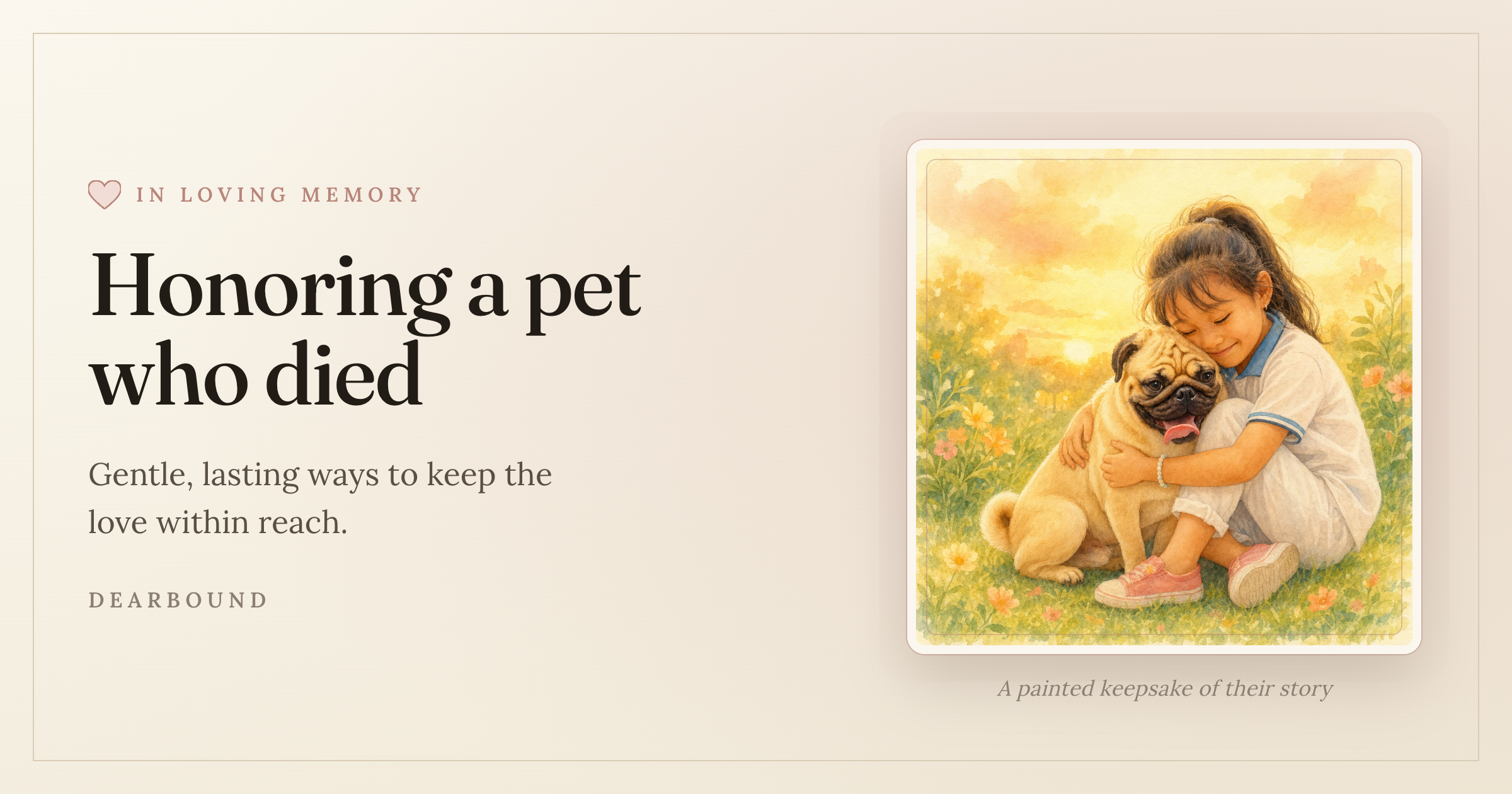
When a pet dies, the house gets quiet in a way that's hard to describe to anyone who hasn't lived it. The food bowl by the door. The spot on the bed. The walk you still half-expect to take. A pet isn't a thing you owned — they were family, and grief for family is real grief, no matter what anyone tells you.
There's no schedule for this, and no right way to feel. But many people find that doing something — making a small, deliberate place for the love that's still here — helps. A memorial isn't about moving on. It's about holding on, gently, to what mattered.
Here are ways to memorialize a pet who died, from the simplest to the most lasting. You don't need all of them. You need the one that feels like them.
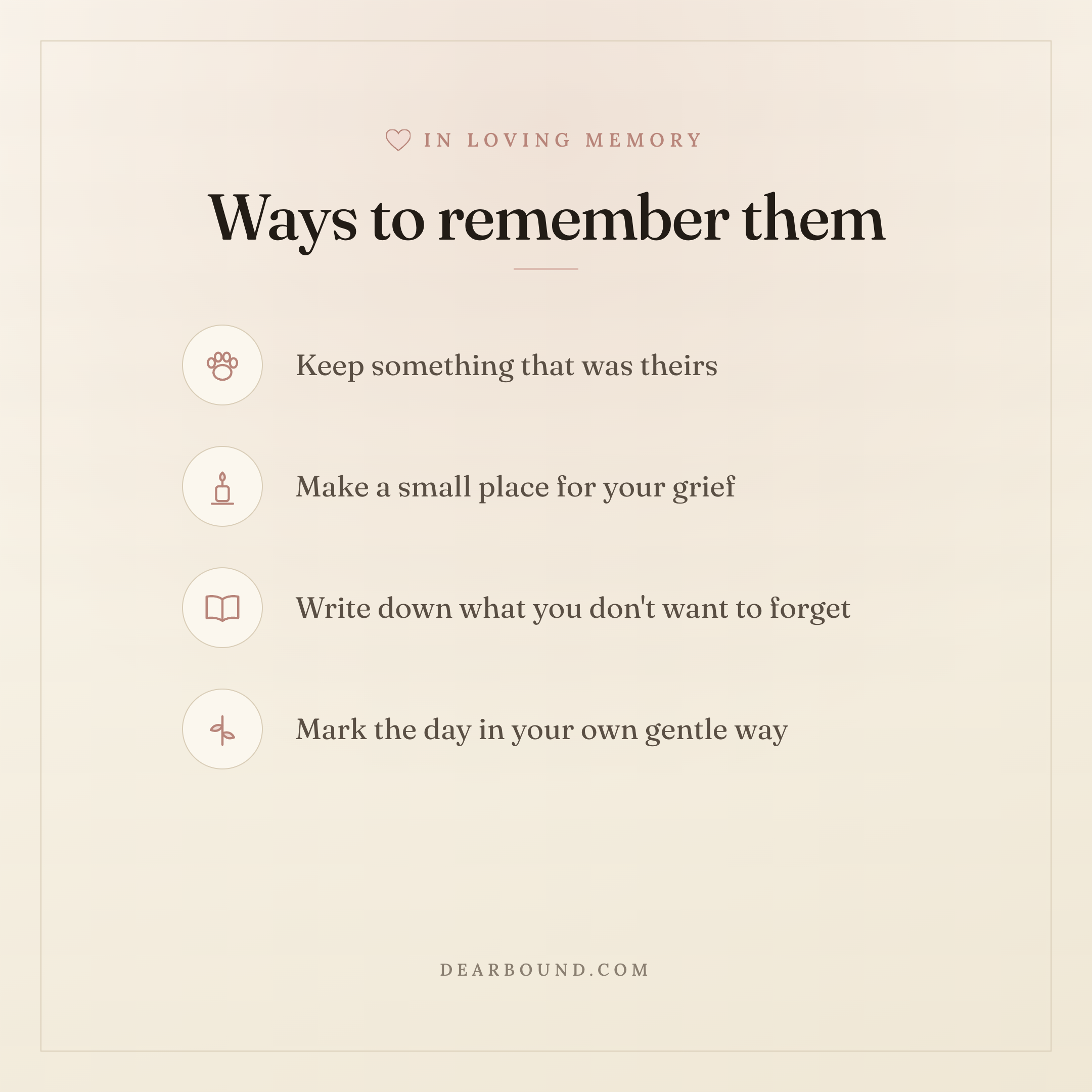
Keep something they touched
The most immediate memorials are the ones already in your home. Their collar, with the tag that still has their name on it. A favorite toy. The blanket from their bed that still smells like them. You don't have to put these away, and you don't have to keep them out — there's no rule. Some people tuck a collar into a small box; others hang it where they'll see it every day.
If you have their paw print, from the vet or pressed into clay, that's one of the most personal things you can keep. A paw print is uniquely theirs.
Make a place to put your grief
A small physical spot — a shelf, a corner, a windowsill — can hold a photo, a candle, their collar, and a few things that were theirs. It gives your grief somewhere to go on the hard days, and it tells the rest of the family that it's okay to miss them out loud.
If you have a garden, a memorial plant or a small stone with their name is a living version of the same idea. You water it, it grows, and the act of tending it becomes a quiet way of staying close.
Write down what you don't want to forget
Grief blurs the small things first — the exact sound of their greeting at the door, the specific way they flopped over for a belly rub, the nickname that made no sense to anyone else. These are the details that make them them, and they fade faster than you'd expect.
Write them down. A list, a letter, a few pages in a notebook. You're not writing for anyone but yourself, and it doesn't have to be good. It just has to be true.
This is also why so many people make a keepsake book about their pet. Putting their whole story in one place — who they were, the ordinary days, the goodbye, and the love that didn't end with it — turns scattered memories into something you can hold and return to. At Dearbound, we make these as personalized, illustrated keepsakes, painted from a photo of your actual pet so the book looks like them, not a generic breed picture. But whether you make a book or fill a notebook, the act of writing it down is the part that matters.
Mark the day, your way
Some families hold a small goodbye — lighting a candle, sharing favorite stories, letting a child say what they want to say. If there are children in the house, including them honestly is one of the kindest things you can do. Children grieve too, and they grieve better when the adults around them don't pretend it isn't happening.
It's okay to use the real words. Your pet died — not "went to sleep," not "went away." Soft euphemisms can leave a child confused or frightened, waiting for a pet who isn't coming back. Honest, gentle language ("Buster died, and that means his body stopped working and he won't come home — and it's okay to be very sad about that") helps a child understand and grieve in a way that half-truths can't.
Give the love somewhere to go
If you're looking for a way to honor your pet that reaches beyond your own home, a donation to a shelter or rescue in their name turns your grief outward. So does fostering, when you're ready — though there's no hurry, and no obligation. Some people find that helping another animal is healing; others need a long time before they can. Both are fine.
How to choose
You don't have to do all of this. Grief is not a checklist. If you're not sure where to start, ask yourself a smaller question: what's the one thing about them I most don't want to lose? The answer usually points you toward the right memorial.
Maybe it's their face — so you keep a photo where you'll see it. Maybe it's their story — so you write it down or make a book. Maybe it's the routine — so you plant something you can tend. There's no wrong answer, because the only thing a memorial has to do is keep a little of the love within reach.
They were family. Missing them is just love with nowhere to go for a while. Be gentle with yourself — and with anyone else in the house who's hurting too.