Helping a Child Cope With the Death of a Pet: A Gentle, Honest Guide
If you're reading this, a pet your family loved has died, or is about to — and now you're trying to help a small person through it while you're hurting too. That's a lot to carry at once. There's no perfect way to do it, and you don't have to get every word right.
What children need most isn't a flawless explanation. It's honesty, and a grown-up who stays close while they feel something big. Here's how to offer both, gently.
Use the real words: "died," not "asleep" or "away"
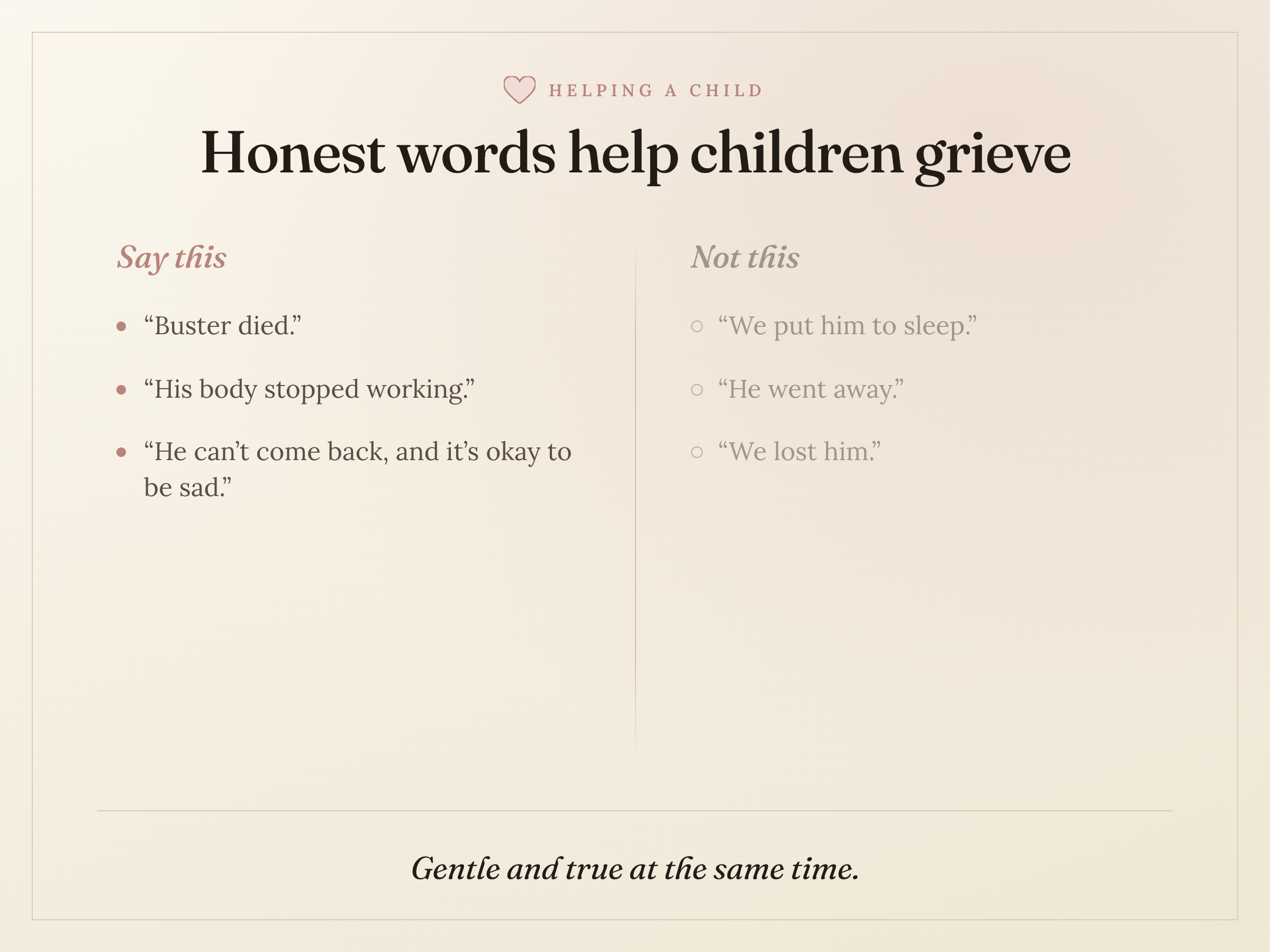
This is the one thing worth getting right. When you tell a child what happened, use plain, honest language: "Buster died." Not "we put him to sleep," not "he went away," not "we lost him."
Soft euphemisms feel kinder, but to a young child they're confusing — and sometimes frightening. A child who hears their pet was "put to sleep" can become afraid of going to sleep, or of you sleeping. A child told the pet "went away" may wait by the door for a friend who isn't coming back. "Lost" suggests the pet might be found.
Honest words don't have to be cold. You can be gentle and true at the same time:
"Buster died this morning. That means his body stopped working, and he can't come back. We won't see him again, and it's okay to feel very sad about that. I'm sad too."
Then let there be a pause. You don't need to fill the silence or fix the feeling. Being honest and staying near is the whole job.
What to expect, roughly by age
Children differ, and grief doesn't follow a schedule. These are patterns, not rules — your child is the expert on your child.
Toddlers and young children
Very young children don't yet understand that death is permanent. Expect repeated questions — "When is Buster coming back?" — asked again and again, sometimes for weeks. This isn't them not listening. It's how small children work an idea through. Answer the same honest way each time, calmly, as many times as it takes.
They may also seem fine one minute and tearful the next, or fold the loss into play. That's normal.
School-age children
Older children grasp that death is final, and the questions get more concrete: What happens to the body? Did it hurt? Could we have stopped it? Answer simply and truthfully at the level they ask. Two questions come up so often they're worth preparing for.
"Is it my fault?"
Children often quietly believe they caused it — that they forgot to close a gate, or were once angry at the pet. Say it plainly, more than once:
"This is not your fault. Nothing you did or didn't do made this happen. Buster got old and sick, and that's nobody's fault."
"Are you going to die too?"
This question is really about safety, so answer the fear underneath it — honestly, but reassuringly:
"I'm healthy, and I plan to be here for a very long time. Most people live a long, long time. My job is to take care of you, and I'm going to keep doing it."
Let them be part of the goodbye
Children grieve better when the adults around them don't pretend nothing is happening. Let them be included, in whatever way fits your family: saying goodbye, helping pick a spot in the garden, lighting a candle, drawing a picture of the pet, choosing one thing to keep.
Giving a child a small, concrete way to act — a job in the goodbye — helps the loss feel less like something that just happened to them. There's no ritual too small. What matters is that they were allowed to take part.
If you'd like more ideas for marking the loss as a family, our guide on how to memorialize a pet who died walks through gentle ways to do it together.
Read it together
For young children especially, a book can be the way in. A story gives a child a frame for a feeling that's too big to hold all at once, and it gives you a script for a conversation that's hard to start — a place to begin when you don't know what to say.
This is the part of the catalog built for exactly this moment. Saying Goodbye ($29) is our children's keepsake for the death of a pet — a 12-page illustrated storybook created with input from children's grief specialists, made to help a child understand what happened and grieve it honestly. It uses the real words, gently, the same way this guide does.
What makes it land with a child is that it's theirs. The pet is painted from a photo of your actual pet and finished by hand, so the animal on the page looks like the one they're missing — not a generic breed picture. (The child in the story is an illustrated, made-up character, not a likeness of your child; it's the pet that's drawn from your photo.) It arrives as a digital, print-ready PDF, hand-finished within 24–48 hours, so you can read it on screen or print it to keep.
A book like this is a tool for the conversation, not a replacement for it. Your honest words, in your voice, are still the thing your child needs most. The book just gives you both somewhere to start.
Be patient with grief that comes back
Grief in children isn't a straight line. A child can seem completely fine for weeks, then fall apart at a birthday, at the sight of another dog, or when a new pet eventually joins the family. Months later, an offhand memory can bring it all back.
This is normal — for kids and for grown-ups. When it resurfaces, you don't have to fix it. Just name it and stay close: "You're missing Buster today. Me too."
Take care of yourself too
You can't pour from an empty cup, and you're grieving this pet as well. You don't have to hide that from your child. Seeing a parent cry — and recover, and keep going — teaches a child that sadness is survivable, and gives them permission to feel their own.
Let yourself be sad in front of them sometimes. It's not a failure to protect them from. It's one of the most honest lessons you'll ever give.
A short, true thing to hold onto
There's no perfect script for this, and you won't find one. But you don't need one. Honesty, presence, and the real words — died, said gently, with you sitting right there — are enough.
Your child won't remember whether you explained it flawlessly. They'll remember that when something hard happened, you told them the truth and you stayed.