The First Christmas Without Your Pet: Getting Through the Holidays
The decorations are in a box somewhere. The loft, the cupboard under the stairs, the top of the wardrobe.
Somewhere in that box is a stocking with their name on it.
You already know it's in there. You've probably known since about October.
This page isn't a list of ways to feel better about that. It's the decisions the next few weeks are going to ask of you — the stocking, the ornament, the cards, the questions at dinner — and the case for making them now, quietly, on your own, instead of at eleven on a Tuesday morning with a room full of people watching your face.
Whatever your season holds — Christmas, Hanukkah, Thanksgiving, or just the long dark end of the year — the shape is the same. A fixed date you didn't choose, arriving with other people attached, built almost entirely out of things you used to do together.
The dread is not you grieving wrong
Grief doesn't stay evenly spread. It collects around dates.
And a holiday is the worst possible date for it, because a holiday is made of repetition — the same food, the same route to the same house, the same walk on the same morning, the same animal underfoot in the kitchen hoping something falls. Repetition is exactly where they lived. Take the animal out and the day is still shaped like them.
So if it's August and you're already flinching at December, nothing has gone wrong with you. You're not backsliding, and you haven't lost ground you'd made. You're looking at a day that has their shape cut out of it, from a safe distance, which is a very reasonable thing to flinch at.
The thought that comes with it — it's been eight months, I should be past this by now — is worth putting down. There is no schedule you are behind on.
Decide the big things now, once
Here's the part that actually helps, and it's less about grief than about logistics.
The exhausting thing isn't the holiday. It's being ambushed by a dozen small decisions in the middle of it, one at a time, in front of people. Do we hang this. Do I say something. Is it weird if I don't. Each one is small. Twelve of them, while you're holding a plate and someone's asking about your job, is not small.
So make them now. In advance, alone, in an ordinary week, where you can take as long as you like and cry about a piece of felt in private if that's what happens. Then in December you're not deciding anything. You're just doing what you already decided.
And one standing permission before any of the rest, because it unlocks all of it:
"Not this year" is a complete answer. You're not deciding forever. You're deciding for one December, and you get to decide differently next year, and the year after that, without explaining the change to anybody.
Their stocking, their ornament, their spot
The objects come first, because they're the ones with a physical deadline attached — they come out of a box on a particular day whether you've thought about them or not.
None of what follows is more loyal than any other. There is no version of this where you love them more.
Their stocking
Three honest options.
Hang it exactly where it always went. Some people find the gap where it should be far worse than the stocking itself.
Hang it and put something in it. A note to them. A photo. The receipt from a donation you made to a shelter in their name. This is the version people tend to land on when they can't bear either extreme.
Or pack it away this year, and decide again next year.
The trap here is guilt, in both directions. Putting it away is not forgetting them, and it doesn't mean you've decided anything permanent. Hanging it is not wallowing, and it isn't going to hold you back. It's a sock. It only means what you decide it means.
Their ornament
If you have one with their name or their face on it: hang it, or hang it somewhere only you will see it. Round the back of the tree is allowed. So is the kitchen, or a shelf in your bedroom, or nowhere.
If you don't have one and find yourself wanting one, it doesn't need ordering from anywhere. A favourite photo trimmed to a circle, a bit of card behind it, a ribbon through a hole punched at the top — that's a ten-minute job at the kitchen table, and people keep those ones for decades.
The spot on the floor
This is the one nobody warns you about, and it's the one that tends to get people.
The bed by the radiator. The patch of carpet under the tree they annexed every year. The end of the sofa. Absence is loudest in the room where the day actually happens, and it's at its loudest when the room is full and warm and everyone else is having a nice time.
Options: leave it exactly as it is. Move it before the day, so it isn't a shock in the middle of the morning. Or deliberately put something there — a candle, a plant, a framed photo — so that the space is occupied rather than empty.
That last one sounds like a small thing. For a lot of people it's the difference between a room with a hole in it and a room with them in it.
The traditions that had them in them
The second set of decisions is about rituals rather than objects. These are the ones that ambush you, because they don't sit in a box waiting to be found — they just arrive at the time they always arrive.
The photo card
Whether to use a picture with them in it. Whether to add a line on the back. Whether to skip cards altogether this year and let it go.
All three are fine. The specific ache to name here is the family photo that now has a gap in it — the first one taken without them, which will be a real moment even if nobody else in the frame notices it. If that's more than you want to do this year, don't do it this year.
Signing their name
"…and Rufus."
Keep it or drop it. Nobody is scoring this. The people who would notice the name missing are the people who would be glad to see it there, and neither group is going to think less of you.
The walk, the morning, the drive
The tradition with a time attached to it. The Christmas-morning walk before anyone else is up. The drive to your parents' with them in the back. The evening they got their own plate.
Three options again: do it anyway, do it differently, or don't do it this year. Doing it differently is underrated — a new route, a different hour, a friend with you. Same tradition, without the exact ghost of it.
The gift you always bought them
A surprising number of people find themselves standing in a pet aisle in December out of pure habit, holding something, before they remember.
If it helps, redirect it: the same money to a shelter, a toy donated to a rescue, a bag of food to a food bank that takes pet food. And if it doesn't help, don't. Some people find that unbearable rather than comforting, and that's allowed too.
Those are the decisions worth making early:
- Their stocking — up, filled, or packed away?
- Their ornament — on the tree, or somewhere only you see?
- Their spot — leave it, move it, or fill it?
- The photo card — use a picture with them in it?
- Their name on the cards — keep signing it?
- The walk — do it, change it, or skip it?
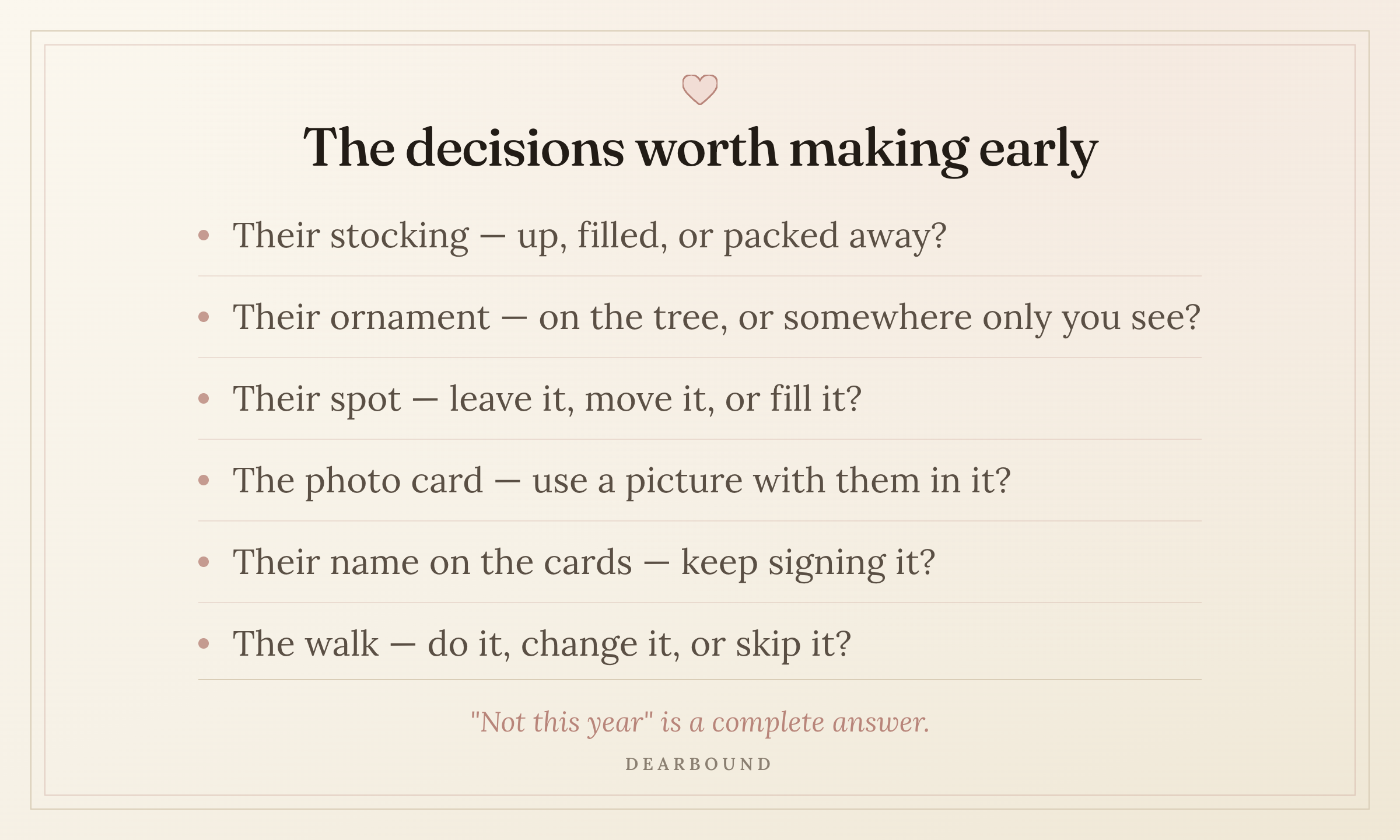
Six answers, decided in an ordinary week in November, and December stops being a series of ambushes.
The gathering, and the questions people ask
For a lot of people the day itself is manageable and the gathering is not. Alone with it, you can do what you like. In a room, you're performing.
"So, are you getting another one?" This is the one people dread, and it's almost always meant kindly — it's someone trying to move you toward a happy ending. It lands like a suggestion that your animal was a category rather than a person.
You do not owe an answer. "Not yet — ask me again next year" closes it warmly. "I'm not ready to think about it" closes it honestly. "We'll see," followed by asking them something about themselves, closes it completely, and nobody ever notices.
The relative who thinks it was "just a dog." You're not required to litigate the size of your grief at dinner. You will not win, they are not really arguing about your pet, and the attempt will cost you the rest of the evening. Let it go and move to a different part of the room.
Tell one person in advance what you need. This is the single most useful thing on this page. Pick one person who'll be there — a partner, a sibling, a friend — and give them one specific instruction ahead of time. If I go outside for ten minutes, don't follow me. Or: if someone brings up the dog, change the subject. One ally who knows the plan is worth more than fifteen people watching your face for signs.
Have an exit. Take your own car if you can. Decide in advance what time you're allowed to leave. Leaving early is not a scene — you have a headache, you've got an early start, and nobody will remember by January.
And if the problem is that the people around you keep saying the wrong thing, you're allowed to hand them something rather than have the conversation yourself. What to say to someone whose pet died is written for them, not for you.
If there are children in the house
The season makes the absence loud for children too, and often more concretely than for adults: the stocking, the photo card, the place at the table, the simple question of who's going to open theirs.
One rule covers most of it. Keep using the real word, and keep saying their name out loud. A child who hears the pet named at Christmas learns that the pet is still allowed to be talked about — that this is a thing the family does, not a thing everybody edges around. Children take their lead on that entirely from the adults in the room.
Let them do their own version, too. A drawing on the tree, a stocking they fill themselves, ten quiet minutes with a photo. It'll look strange to you and it will make complete sense to them.
We wrote a fuller guide on helping a child cope with pet loss. If a child in your house is still carrying this and struggling to put shape to it, Saying Goodbye ($29) is our 12-page personalized storybook written for exactly that — helping a child understand and grieve the pet they lost, in words made for them rather than for adults.
If there's another pet still at home
The animal who's left has had a strange few months as well, and the holidays make it stranger: the house is louder, there are visitors, the routine goes sideways, and the other one isn't there.
We're not going to tell you what they understand about any of it, because we don't know and neither does anyone else selling you something. What is fair to say is that a disrupted routine is genuinely hard on an animal, and steadiness is the thing that helps.
So: same walk, same times, same bowl, as far as the season allows. A quiet room away from the gathering, with the door shut and their own bed in it. And a little grace for behaviour that's out of character while the house is full of strangers and everything smells different.
It's also, on the harder days, not nothing to have something warm that still needs walking at seven in the morning.
Making them present instead of absent
Most people go into the holidays planning to get through them — heads down, reminders minimised, survive until January.
It's worth knowing that the opposite often works better.
When there's no room made for them anywhere in the day, the grief doesn't go away. It just waits, and then arrives without warning, usually at the table, usually mid-sentence. When there's a deliberate, contained place for them in the day, it tends to arrive there instead — where you're expecting it, on your terms, and where you've decided how long it lasts.
Contained is the important word. A moment, not the whole day. And nobody else is obliged to join in.
A few shapes that work:
- A candle lit at the start of the meal, with or without an explanation.
- A toast. One line, their name in it.
- Telling one story about them out loud — the funny one, not the sad one. The time with the turkey. The year they got into the presents.
- Five minutes alone before anybody arrives, in the room where their bed used to be.
- Something written to them, read on the day. If that's your instinct, we have a page of prompts for writing a letter to your pet who died.
Some people want something more solid than a candle — something to actually hold on a day when their absence is the loudest thing in the room. If that's you, The Story of Your Pet ($32) is what we make for it: an 8-page personalized keepsake that tells the whole story of a life — who they were, the ordinary days, the goodbye, and what stayed — written in your voice, to them, and written for grown-ups rather than children. Its seven illustrations are painted from a photo you upload and then finished by hand, so the animal on the page is your animal, with their own coat and their own face. It arrives as a digital, print-ready PDF, hand-finished within 24–48 hours, so there's nothing to ship and no postal deadline to work backwards from. And if it isn't for you, the candle and the story told out loud are the same idea and cost nothing at all.
For the longer-term ways of doing this — the ones that aren't tied to a date — there are gentle ways to memorialize a pet who died.
If the loss is very recent
If your pet died a few weeks ago rather than a few months ago, this page is probably asking too much of you.
You do not have to make six decisions. You don't have to host, or attend, or send cards, or find a meaningful way to include anybody in anything. Cancel it. Let someone else do it. Order food and watch television and let the day pass without a shape.
The practical things — the first days, what to do next — are here: what to do when a pet dies.
Everything on this page will keep until next year.
Whatever you choose is allowed
Decide early. Decide small. Decide alone, in an ordinary week, before the box comes down.
Hang the stocking or don't. Sign their name or don't. Light the candle, or sit in the kitchen for five minutes at some point in the afternoon and think about them on purpose, and let that be the whole of it.
And whatever you pick this year, you can pick something else next year. Nothing you decide in November is a verdict on how much you loved them.
It's going to be a strange day. It was always going to be, and no arrangement of ornaments was ever going to fix that.
But you get to decide where they go in it — and a day with a place for them in it is a great deal easier than a day spent trying not to notice they're gone.