How to Write a Pet Obituary (With Examples You Can Adapt)
Someone has to tell people, and it's you.
The family three time zones away. The friends who knew her as a puppy. The dog walker, the groomer, the neighbor who always stopped at the gate to say hello to her. At some point in the next few days you'll sit down to write a few lines about your pet, for other people to read, and the empty box on the screen will look enormous.
A pet obituary isn't a strange thing to write. It doesn't need to be long, and it doesn't need to be polished. It needs to be true, and it needs to sound like the animal you lived with.
Below: what goes in one, how much to say about how they died, which length fits which place, and three full examples you can adapt.
If your pet died today, in the last few hours, this can wait. The practical things come first, and what to do when a pet dies is the better page for right now. Telling people can wait a day. Nobody who loved them will mind.
Who it's for decides how long it is
Before you write a word, decide who you're writing for. There are really three possible readers.
The people who knew your pet. Family, close friends, the walker, the vet team. They need the news and one or two details that bring the animal back for a second.
The people who know you. Colleagues, a wider circle online, the other parents at school. Plenty of them never met your pet. They need the news, said plainly, and enough to understand why you're quiet this week.
You, a year from now. The longest version is often for nobody but you: a page to come back to when the details start to blur.
Pick one before you start. The length and the tone follow from it.
If what you most want to say is to them rather than about them, that's a letter, not an obituary, and we have a separate guide to writing a letter to your pet who died.
What to put in it
Every pet obituary has roughly the same parts. What makes one sound like a person rather than a form is how specific you are inside each of them. Take the parts that fit and leave the rest.
Their name, and what you actually called them
Start with the name on the vet's file if you like, but don't stop there. The nicknames are where the personality lives.
Rosie (Ro, Rosie Posie, and Rosemary Elizabeth when she'd been in the trash) died on Tuesday.
How long you had them, and how they arrived
One sentence of origin story is enough. It tells everyone how long this lasted without any arithmetic.
We met Rosie at a shelter in 2012. She chose us, loudly.
Three true things
Not the milestones. The habits. The spot on the stairs that was theirs, the sound they made at the door, the thing they stole when nobody was looking. Small, exact details are what make an obituary about this animal rather than any beloved pet. Three is enough.
She slept on the third stair, where everyone had to step over her. She could hear the cheese drawer from two floors away. She stole one sock a week and never chewed a single one.
Who they leave behind
The people, and the other animals. A "survived by" line can be played completely straight or gently funny. Both are honest, and you know which one your pet would have suited.
She leaves Dan and Leah, and Tuck, the cat who put up with her for nine years and has been checking the stairs all week.
How they died, as much or as little as you want
One sentence is plenty, and none is fine too. This is the part that stops people most often, so the next section is all about it.
She died on Tuesday, at home, with her head in Dan's lap.
A last line
Plain beats grand. The last line doesn't have to sum up a life. It only has to be true.
We'll miss her. We already do.
How much to say about how they died
You owe no one the details. Not your followers, not your colleagues, not the cousin who will want to know exactly what happened. You can say a lot, a little or nothing, and each of those is a complete, honest notice.
Three levels, each with a line you can use:
Nothing about how.
Rosie died on Tuesday, at home.
Plainly.
Rosie had been ill for a few weeks. On Tuesday we made the decision with our vet, and she died at home with all of us there.
Not yet.
Oscar died suddenly on Sunday. We're not ready to say more than that yet.
That last one is worth keeping in your pocket. It tells people what happened, asks them gently not to ask, and gives you time.
If you chose euthanasia
You can name it or not. "The decision" is enough. So is "with our vet's help," and so is saying nothing about it at all. You don't have to explain it or defend it in a notice. The people who matter to you already understand.
A thank-you to the vet team
If your vet, or one particular nurse, was kind at the end, a line for them is a lovely thing to include. It's optional.
Thank you to our vet and her team, who were so gentle with her, and with us.
Leave the last day's details out
What happened medically on the last day belongs to you and the people who were there. A notice doesn't need the diagnosis or the clinical detail, and those are hard to read for people who loved your pet too. Anyone who wants to know more will ask you privately.
Three lengths, for three places
The same few facts, at three different lengths. Start with whichever one you need first.
The one line
For a photo caption, the back of a frame, a garden stone or a small plaque. A name, the years, and one true thing.
Rosie. 2012 to 2026. Best girl, terrible listener.
One true detail does more than four adjectives. If you never knew their birthday, the years they were yours are the right ones to use.
The short post
For social media, the family group chat, or the message to the walker, the groomer and the neighbor. Three to five sentences and one photo. This is probably the version you'll need first.
Rosie died on Tuesday, at home, with all of us there. She was fourteen, and she'd been ours since a shelter in 2012, when she chose us very loudly. She slept on the third stair for most of those years, and we're still stepping over it. Thank you to everyone who loved her, walked her, or slipped her cheese. We'll miss her. We already do.
A few decisions, a sentence each:
- Friends only, or public? If you're unsure, start with friends only. You can share it wider later; you can't easily take it back.
- One photo, not twenty. Pick one from an ordinary good day, where they look like themselves.
- Tell the closest people first. Anyone who'd be hurt to find out from a feed deserves a message before the post goes up.
- You never have to post at all. A message to the five people who knew them is a complete announcement too.
The full obituary
For a memorial page, a sheet printed for a small gathering, or the local paper. A few short paragraphs, built from the parts above. The dog example further down this page is about this length.
If you're thinking of the newspaper, some local papers do run pet obituaries, usually as a paid notice with a word limit, so ask yours before you write the long version.
If you're going to read it aloud
A eulogy for a pet is the same piece of writing, said out loud: at a burial in the garden, or with a few people who knew them. A few things change when it's spoken.
- Shorter sentences than you'd write. You need places to breathe.
- One story, not five. Pick the one that sounds most like them and tell it properly.
- A last line you know you can get through. Say it out loud a few times beforehand.
- It's fine to ask someone else to read it. Write it, hand it over, and stand where you can hear it.
Examples you can adapt
Three full examples, in three different registers. We wrote them for illustration, so change every detail: the names, the habits, the tone. The shape is the part to keep.
For a dog, tender
Rosie (Ro, Rosie Posie, and Rosemary Elizabeth when she'd been in the trash) died on Tuesday, at home, at fourteen.
We met her at a shelter in 2012, when she was a puppy with enormous feet. She chose us, loudly, and never really stopped talking. She slept on the third stair, where everyone had to step over her. She could hear the cheese drawer from two floors away. She stole one sock a week and never chewed a single one; after she died, we found them all under our bed, in a neat pile.
She had been ill for a few weeks, and on Tuesday we made the decision with our vet. She died with her head in Dan's lap.
She leaves Dan and Leah, and Tuck, the cat who put up with her for nine years and has been checking the stairs all week.
We're still stepping over the third stair. We'll miss her. We already do.
For a cat, dry and affectionate
A funny obituary isn't disrespect, if funny is who they were.
Oscar, a large orange cat of firm opinions, died on Sunday at seventeen.
He arrived as a kitten in a cardboard box from a neighbor's barn, and he never forgave anyone for the box. He spent the next seventeen years on the warmest available surface, which was usually the radiator and occasionally a laptop someone was using. He never once came when called. He came when the can opener was used, which he felt was the same thing.
He is survived by two people he tolerated, one dog he did not, and a radiator that will never be properly warmed again.
We loved him more than he let on he loved us back, which was, we think, quite a lot.
For a rabbit, a bird or a small pet, short
A small animal's notice can be small too, and still say everything.
Bean, our lop-eared rabbit, died this week. She was six. She thumped at thunder, at the vacuum, and once, for reasons she kept to herself, at a paper bag. She let exactly one of us rub her ears, and it was never the one who cleaned the hutch. The hutch is very quiet.
What to leave out
The apology for grieving. "I know it's just a cat, but." Drop the first half. You don't need anyone's permission to be sad about an animal you lived with for seventeen years.
Blame, of anyone. A vet, a driver, a pet sitter, yourself. A public notice is the wrong place for it: it will read differently in a month, and the people reading it can't answer it. If some of that blame is aimed at yourself, it deserves somewhere gentler than a feed.
The medical history. A list of diagnoses isn't who they were.
A stack of borrowed phrases. "Crossed the rainbow bridge," "forever in our hearts," "run free." One of them, if it's genuinely yours, can be exactly right. Five in a row because a template had them, and your pet disappears behind them. A pile of stolen socks under the bed says more than all five.
When the replies come in
You don't have to answer each one. A single thank-you a few days later covers everyone.
Thank you, every one of you, for the stories about Rosie. I've read them all, even the ones I couldn't answer.
You're also allowed to mute a thread, put the phone in a drawer, and come back to it next week. The kind messages will still be there.
And if you've landed here from the other side, because someone you know has posted and you're trying to write a reply, we've written that page too: what to say to someone whose pet died.
If a child wants to help
Let them. A child who loved the animal may want to add a line of their own, and it belongs in the notice exactly as they wrote it: uncorrected, misspelled if it's misspelled, about whatever mattered most to them.
Rosie was my best friend and she was scared of balloons. Love, Ivy, age 7
For the rest of that conversation, we have a gentle guide on helping a child cope with pet loss.
If you want the longer version
An obituary is the short version: about them, for other people. Sometimes, later, you want the long version too, written in your own voice, to them, and kept for yourself.
That's what The Story of Your Pet is. It follows the same shape this page has walked through: who they were, the ordinary days, the things only they did, the goodbye, and what remains. After checkout you answer a few questions (their name, how they looked, the ritual that was the best part of the day, their favorite thing in the world) and upload a photo. An optional question asks how they died, and the goodbye page is written to match your answer, the decision included. Its seven watercolor illustrations are painted from your photo and finished by hand, so the animal on the page is your animal. It's $32 for 8 pages, delivered as a digital, print-ready PDF within 24 to 48 hours.
If you've already written the notice, you don't need anything else. The few true lines you wrote for other people were the important part.
The short version
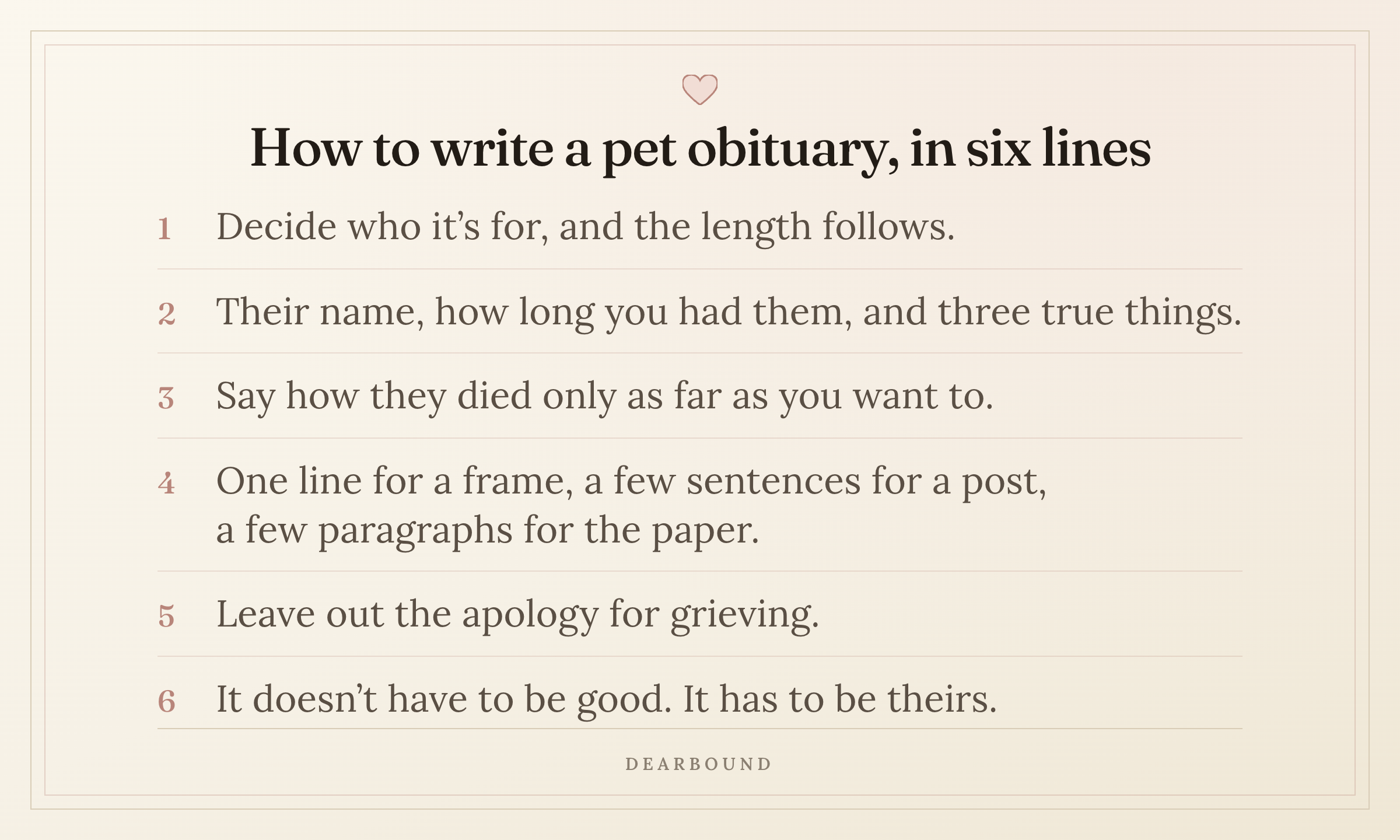
How to write a pet obituary, in six lines:
- Decide who it's for, and the length follows.
- Their name, how long you had them, and three true things.
- Say how they died only as far as you want to.
- One line for a frame, a few sentences for a post, a few paragraphs for the paper.
- Leave out the apology for grieving.
- It doesn't have to be good. It has to be theirs.
None of this has to be finished today, or long, or clever. Write down the three true things first, even if that's all you manage. Your pet's version of the third stair, the cheese drawer and the socks under the bed is what people will remember reading, and what you'll be glad you wrote down.