Pet Memorial Sayings: What to Write on a Stone, Urn or Ornament
The maker's form has a space for the inscription, and it isn't big. Room for a name and a line, perhaps the years. Whatever goes in it will be carved, engraved or painted onto something you'll see for a long time, and you're being asked to choose it, often in the weeks after your pet died.
That's a strange job to be handed. Most lists of pet memorial sayings help with half of it: they give you lines. The other half is the decisions that come before a line, like which name to use, whether to include dates, whose voice it's in, and what to do when the family doesn't agree.
This page has both. The decisions come first, then lines you can copy or change, sorted by where they're going: a garden stone, an urn, an ornament, a frame. If you're still deciding what kind of memorial to make at all, we wrote about the gentler options in how to memorialize a pet who died.
Before you choose a line, ask how much room there is
Start with a question for the maker: how many lines, and how many letters fit on each. It differs from one maker to the next and from one object to another, so the number on someone else's stone won't tell you yours.
It helps to think of an inscription as three small things stacked on top of each other: a name, a span of time, and a few words about them. On a small enough space, one or two of those is plenty.
It also helps to know which kind of object you're writing for. Carved and engraved things are permanent. An ornament, a painted stone or a frame can be redone next year if the words stop feeling right. Spend the most care where it can't be changed.
For a one-line caption under a photo, our guide to writing a pet obituary has the short version, and a word on why a string of borrowed phrases tends to hide the animal behind it.
Three decisions most lists skip
Which name
Chester was the name on his adoption papers. At home, for twelve years, he was Chess.
When it comes to a stone, the official name can feel like the more respectful choice. But you're the one who'll read it, for years, and the name you said a hundred times a day is usually the one that sounds like him. You don't have to choose, either. Both may fit:
Chester, our Chess
Or put one name on the stone and the other on something smaller and closer, like the ornament. Either is right.
Which dates, if any
There are four honest options: the years they were born and died, the years you had them, only the year they died, or no dates at all. Years take far less room than full dates, and on a small plate that can be the difference between having a line and not having one.
Chess. Ours, 2014 to 2026.
For an animal who came from a shelter or turned up as a stray, the year they came home is a perfectly good first date. It's the year your part of the story began. And no dates is fine too: a name and a line can say more than a date does.
Whose voice
There are three, and each one reads differently to the person standing in front of it.
About them. Written for anyone who walks past, including people who never met them. It suits a garden stone.
He thought this garden was his. It was.
To them. The most private of the three, spoken straight to them.
Thank you, Barley.
From them. In their own voice. Some families always talked for their pet, in a particular voice everyone in the house could do. Use this one only if that's how your family talked about them; otherwise it can read like a joke somebody else made.
Barley, 2013 to 2026. I was worth the mud.
Pick one voice for each object. In a line this short, two voices start to pull against each other:
Thank you, Barley. He loved it here.
That line reads as if it changed its mind halfway through. Either half on its own is fine.
Lines you can use
Every line below was written for this page, so there's nobody to credit and nothing to get exactly right. Take one as it is, change the name, or keep the shape and swap in what was true of your animal.
Short enough for a small stone or an urn plate
Two to five words, for the smallest spaces.
Ours from the first day.
Easy to love.
Old friend, well loved.
Gentle with everyone.
Twelve good years.
For a dog
A habit says more than an adjective. Barley's family could have written "loyal" and "loving," and so could every family with a dog.
Barley. Wet from April to October.
Barley. He howled along with every siren on our street.
Barley, 2013 to 2026. His path is still worn along the fence.
For a cat
Winnie was a quiet cat, so her lines are quiet ones.
Winnie. The quietest company we ever had.
Winnie, who purred before you'd even touched her.
Winnie watched the birds for fifteen years and caught none of them.
For a rabbit, a bird or a small pet
Toby. A small rabbit with a nose that never stopped.
Our little bird, who rode everywhere on somebody's shoulder.
When they were funny
A stone is allowed to make someone smile. If they made you laugh every day for ten years, a line that does the same is a fair likeness.
Barley. Dug up every bulb we planted, and most of next door's.
Winnie, who knocked one thing off every shelf we owned.
Keep the joke about who they were, never about how they died.
One stone for two
When two animals lived together, they can share one marker. Give each of them their own name and years, then one line for both, rather than half a line each.
Bruno, 2011 to 2024
Sadie, 2013 to 2026
They were never far apart.
Bruno and Sadie. Eleven years side by side.
Where it's going changes what it says
The same words read differently on a stone in the rain and on a small plate you hold in your hand. One practical note covers all of them: simple lettering stays easy to read for longer, and the maker will tell you what their material can hold.
On a garden stone or grave marker
A stone outside gets read by whoever walks past, in every kind of weather, for a long time. That suits the about-them voice, and a line someone who never met them would still understand. It's also the most permanent thing on this page, so once you have the line, sleep on it.
Barley, 2013 to 2026. Happiest outdoors.
Winnie. She liked it out here.
On an urn
An urn usually lives indoors and gets read up close, mostly by you. That makes it the place for the to-them voice, and for the nickname nobody outside the house would understand.
Home with us, Chess.
Chess. Our good old man.
On an ornament
An ornament is small, it comes out once a year, and whoever is decorating reads it up close every December. So write a line that will still be true in ten Decembers, rather than one about this one. "Our first Christmas without you" is true exactly once. Their name and the years will hold, and so will one line about who they were.
Poppy, 2012 to 2026.
Poppy. Fourteen Christmases with us.
Whether it goes on the tree at all is a separate decision, and we wrote about that one in the first Christmas without your pet.
In a frame, a shadow box or an indoor plaque
These can hold a little more. They're read up close and at leisure, and a frame or a shadow box can be rearranged later. A whole sentence fits here, sometimes two.
Winnie arrived in a snowstorm and stayed for fifteen years.
Barley wore this tag for thirteen years of walks.
If your family believes different things
Not everyone in a family believes the same thing about what happens after a pet dies, and a stone is a small place to settle it. You don't have to settle it there.
A line that makes no claim about where they are now is true for everyone who reads it:
Loved here, every day we had.
Every line on this page is written that way on purpose, so any of them can sit beside whatever you believe. If you do believe they're somewhere, say it the way you would say it, in your own words. It's your family's stone, and nobody reading it is owed an explanation.
If other people want a say
The kids
A child may not want to write the line, but they might have the word. Iris is eight. Asked for one word about Barley, she said "wiggly," because he wagged with his whole body. It went on the stone under his name. In twenty years it will read as her memory of him, which is exactly what it is.
If the stone is already decided, give them one of their own: a smooth stone from the garden, some paint and an afternoon. Two stones in one garden is fine.
If the harder part is the conversation itself, helping a child cope with the death of a pet is written for that.
When the family can't agree
Sometimes everyone has a line, and no two are the same. There are two kind ways through.
A shorter line everyone can live with. Often it's the one thing nobody argues about.
Barley. We all loved him.
Only the name and the years. Then everyone keeps their own line somewhere else: a card in the frame, a note tucked in with the ornament, a page in a journal.
Before you send it to the maker
A few checks, none of them rules:
- Read it aloud once. If a word doesn't sound like you, you'll hear it.
- Check the spelling of the name, and of the nickname. Is it Chess, or Chez? Decide before the maker does.
- Count it against the space the maker gave you, and ask whether spaces and punctuation count too.
- Show it to one person who knew them. They'll know at once whether it's the animal they remember.
- Keep the lines you didn't use. One of them may be right for the ornament, or for next year.
- Wait, if you'd like to. Nothing about the wording has a deadline except the one the maker gives you.
When one line isn't enough room
A stone takes a few words. If you started with a page and cut it down to six words, the rest of that page still has somewhere to go. You can write it to them yourself, as a letter: how to write a letter to your pet who died has prompts for the first line and the ones after it, and it costs nothing but an evening.
Or you can have help with it. A Letter to Your Pet was made for what the stone couldn't hold: six pages addressed to them, in your voice. The stone says a line, and the letter says what the line had to leave out. Once you've ordered, the form starts with one photo and then asks its questions, among them who should sign it, any nicknames (printed under the signature, if you'd like), the last good day if you have one, what you're keeping, and where you'd like the letter to say they are now. That last question has three answers, and one of them, "kept in memory and presence," makes no claim at all. The portrait on its cover is a watercolor painted from your photo, and it's all finished by hand before it's sent. It's $29, and it comes as a digital, print-ready PDF within 24 to 48 hours, for printing on cardstock and framing.
Either way, the stone doesn't have to carry all of it.
The short version
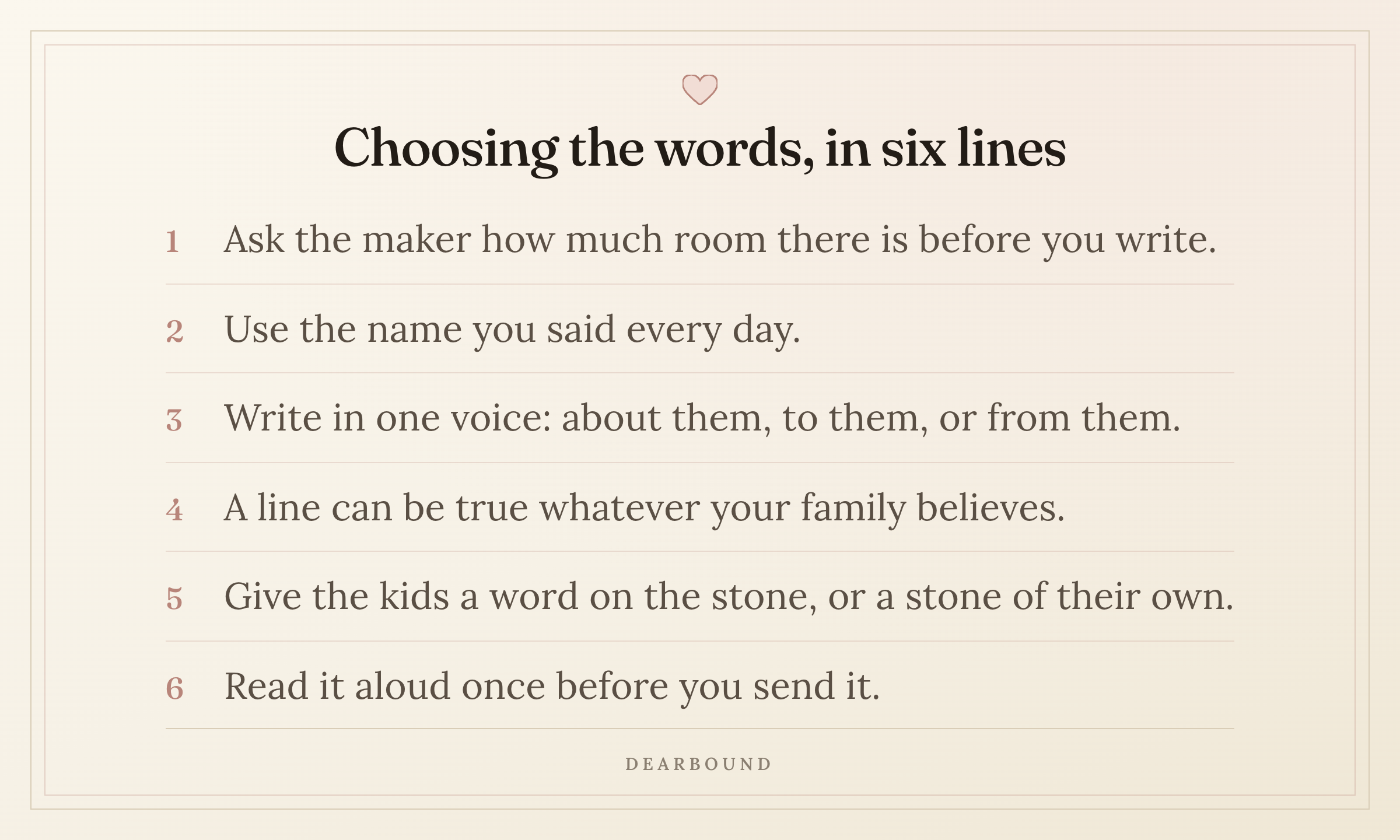
Choosing the words, in six lines:
- Ask the maker how much room there is before you write.
- Use the name you said every day.
- Write in one voice: about them, to them, or from them.
- A line can be true whatever your family believes.
- Give the kids a word on the stone, or a stone of their own.
- Read it aloud once before you send it.
A stone doesn't have to tell a stranger everything. It only has to sound like them to the people who knew them, and to you, each time you see it.