How to Write a Letter to Your Pet Who Died: Prompts to Start
It isn't strange to want to write to a pet who died. Plenty of people do. Some fill a page in a notebook nobody will ever see. Some write a few lines on the back of a photograph. Some say it out loud, at the spot in the garden, and never write a word of it down.
Grief needs somewhere to go, and a letter gives it a direction. It's a way of finishing a conversation that ended before you were done talking.
This is a guide for when you want to write one and don't know how to begin. There's no right length, no right day to do it, and nobody is going to grade it.
If your pet died only hours or days ago, you may not need this page yet. The practical things come first, and we have a gentler starting point for that: what to do when a pet dies. The letter will keep. It'll still be there next week, or next year.
Why writing to them helps
Grief for a pet is real grief, but it rarely gets treated that way. You're expected back at work on Monday. The size of what you're carrying doesn't match what the world gives you permission to say about it, so most of it stays inside, unsaid, taking up room.
A letter is a place where you're allowed to say all of it, at full size, to the only one who never needed any of it explained. You don't have to justify how much it hurts. You don't have to reassure anyone that you're coping. You can say the enormous, embarrassing, true things — you were the best part of my day for eleven years — without watching someone's face for a reaction.
That's the whole of it, really. Not a technique, not a treatment. Just somewhere honest to put it down.
Some people find that the writing settles something. Others find it opens everything back up for an afternoon, and that's all right too. If the grief is more than you can carry on your own, it can help to talk to someone — a friend who understood what your pet was to you, or your vet, or a counsellor. Writing a letter and needing more than a letter are not in competition.
There's no wrong way to do this
Most people never write the letter because they're waiting to do it properly. So, plainly:
- Handwritten or typed — whichever gets words onto a page. Handwriting is lovely to keep; a phone at midnight is also completely valid.
- One sitting or ten. You can stop mid-sentence, close it, and come back in three weeks.
- A page or a paragraph. Short and true beats long and dutiful.
- Spelling doesn't matter. Neither does grammar, or crossing things out, or starting again on a clean page.
- Use the silly name. Not the one on the vet's file. The nonsense one that only made sense in your house.
- Nobody else has to read it. Not your family, not anyone. It can be a completely private thing.
If you're staring at a blank page and freezing, that's the most normal part of this. Skip ahead to the prompts further down this page and start in the middle. Letters don't have to be written in order.
What to put in the letter
There's no required shape, but most letters to a pet move through roughly these beats. Take the ones that fit. Leave the ones that don't.
Start by saying their name
Address them directly. Dear Bailey. It seems like a small thing, but it changes what comes out of you — writing to them instead of about them puts you back in the room with them. Whatever you were going to say formally tends to dissolve at that point, which is exactly what you want.
If even that line is hard to write, write it anyway and then go and do something else for an hour. The first line is the heaviest one in the letter.
The ordinary days
This is the most useful instruction on this page: don't write the milestones. Write the Tuesdays.
Not "you were a good boy" — the 6 a.m. nose against your arm, ten minutes before the alarm, every single morning. The third stair, which was theirs. The specific noise they made when you picked up the leash. The way they arranged themselves on the sofa when they thought you weren't looking. The smell of their ears.
The small, exact, unremarkable things are what make the letter them rather than any beloved animal. They're also the details grief blurs first, which is a good reason to get them onto paper while you still have them.
Thank you
Say what they gave you, plainly and without decoration. The years they covered. The particular bad stretch they got you through without ever knowing they were doing it. The walks that got you out of the house. The company, on days when you didn't want any from a person.
You can be specific here and it will not sound sentimental. Thank you for sitting outside the bathroom door when I was crying and pretending I wasn't is a real sentence, and it's worth more than a paragraph of praise.
The apology, if you're carrying one
A lot of people are carrying one. The decision. The timing of the decision — too soon, too late, you'll never settle it. The appointment. The I should have noticed sooner. The trip you took that turned out to be their last week, when you didn't know it was.
A letter is a reasonable place to set that down. Write it as plainly as you'd say it if they were in the room: I'm sorry I wasn't there at the end. Don't soften it. It's yours to say.
And then, if you can, write the true thing next to it: you made that decision with the information you had, at the time you had it, because of how much you loved them. Both things can sit on the page together. You don't have to resolve them today, and you don't have to forgive yourself on a schedule to have written a good letter.
The goodbye — only if you're ready to write it
The last day, if it wants to be written.
If it doesn't, leave it. You are allowed to write a whole letter that skips it entirely. You can put a line in that just says I'm not ready to write about that day yet, and stop there — that sentence is honest and it holds the space open. Some people come back to it a year later. Some never do, and their letter is not unfinished.
Whatever you do, don't let the hardest part of the letter stop the rest of it from being written.
End with what you're keeping
Don't let the letter end at the goodbye.
Tell them what stays. The habit you've kept — still walking the same route, still buying the same brand of biscuits for the neighbour's dog. The way you still say their name out loud in the house. What they taught you about being patient, or about being loved without having to earn it. The people who came into your life because of them.
This is the part that turns a letter into something you can reread. It ends where the truth actually ends, which is not at the death.
Prompts for when the words won't come
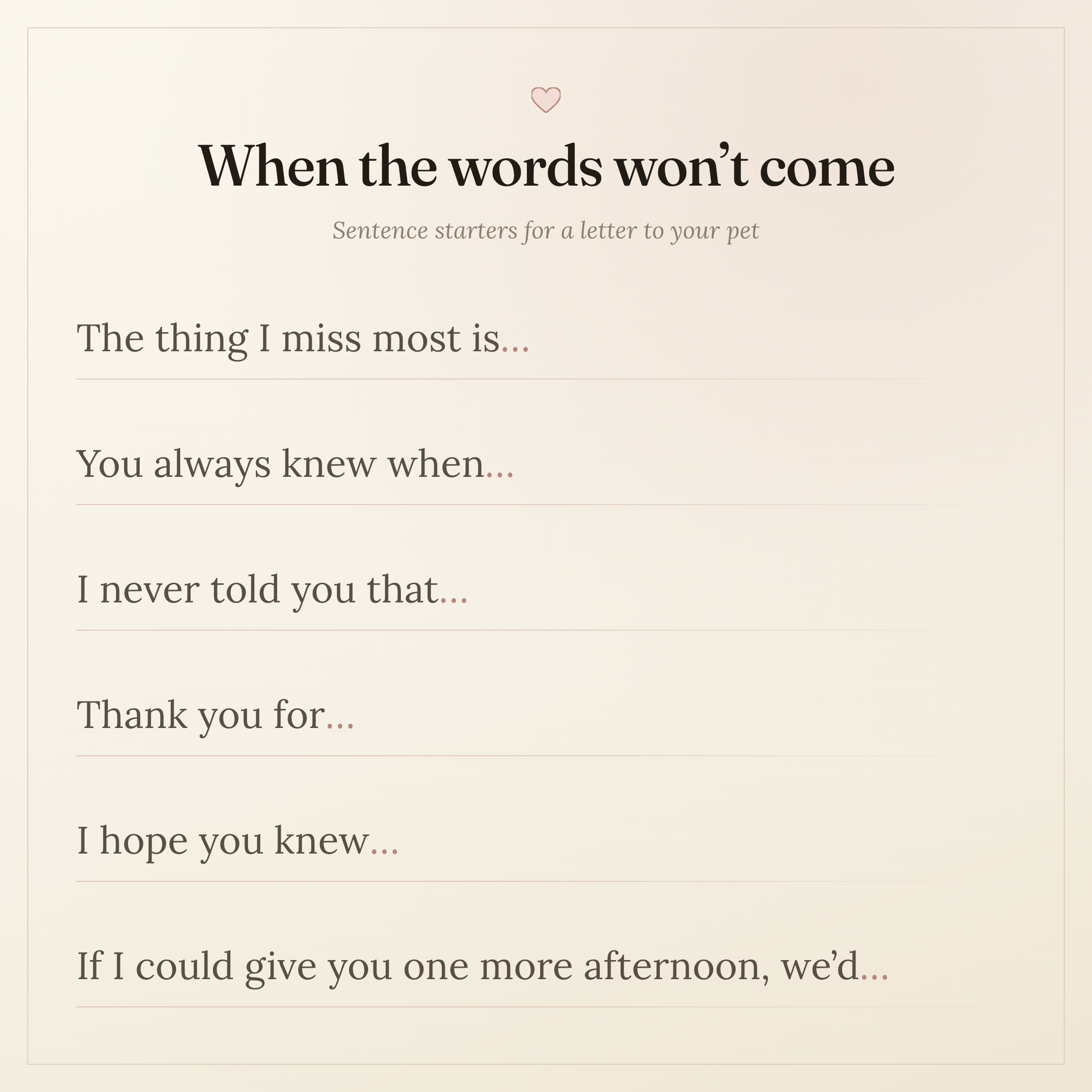
Copy any of these onto a page and finish the sentence. There's no order, and you don't need all of them — two or three usually opens the rest.
- The thing I miss most is…
- You always knew when…
- I never told you that…
- Nobody else knows that you…
- The thing you taught me was…
- I still catch myself…
- Thank you for…
- I'm sorry about…
- I hope you knew…
- The last good day was…
- The house is different now because…
- If I could give you one more afternoon, we'd…
If a prompt makes you stop cold, that's usually the one with something underneath it. Come back to it when you're ready.
What to do with the letter when it's finished
Nobody tells you this part, so here are the things people actually do.
Read it aloud to them. At the spot in the garden, at the shelf where their photo is, in the car. Saying it out loud does something that reading it silently doesn't.
Keep it folded with their collar, or in the box with their paw print, or tucked into the back of a photo frame.
Bury it with the plant, or with the ashes, if that's what feels right.
Put it in a drawer and reread it next year. You'll notice it's changed — not the words, but what they cost you. That's usually the first evidence that anything is shifting.
Or throw it away. Genuinely. Some people burn it or tear it up, and the letter still did its job. The writing was the point; the paper was just where it landed.
If there's a child in the house who wants to write one too, let them. Children often reach for this on their own, and they should be allowed the real words — their letter doesn't need to be tidied up or corrected. If you'd like help with the wider conversation, we have a gentle guide on helping a child cope with pet loss.
If you'd rather not start from a blank page
For some people the blank page is the obstacle. Not the feelings — the starting. A bit of structure helps more than total freedom does, and if that's you, this is what we make.
A Letter to Your Pet ($29) is a 6-page personalized letter written in your voice, to them. It walks the same beats this article does — the ordinary days, the thank-you, the apology that lifts some of the weight, the last good day, and what you're keeping. We write the connective words with care; you supply the specifics that make it theirs and nobody else's. It's illustrated with a watercolor portrait painted from a photo you upload and finished by hand, so the animal on the page is your animal. It arrives as a digital, print-ready PDF within 24–48 hours, made to be printed on cardstock and framed.
Its companion, A Letter from Your Pet ($29), is the same idea written the other direction — a letter in their voice, back to you — and some people keep both: one letter from them, one from you.
Neither of these replaces the one you write yourself in a notebook at 11 p.m. If you've already written that one, you don't need anything else.
A letter isn't the only way
If writing genuinely isn't your thing, the instinct behind it still is — you want somewhere to put the love. It fits other shapes just as well: a photo box, a plant you tend, a small spot on the shelf with their collar on it. Our guide on how to memorialize a pet who died walks through the gentler options, from the simplest to the most lasting.
Any of them work. The only thing that doesn't work is having nowhere for it to go.
You're not writing to no one. You're writing to keep them — the ordinary Tuesdays, the noise at the door, the name you still say out loud in an empty kitchen.
The letter is just proof that the love had somewhere to go.