What to Say to Someone Whose Pet Died (and What Not to Say)
You have typed the message three times now, and deleted it three times.
I'm so sorry for your loss — too stiff, it sounds like a form letter. He was such a good boy — is that too much? Not enough? So the message sits there unsent, and an hour goes by, and then a day, and now it feels late, and late feels worse than clumsy.
Here's the thing that takes the pressure off: the only real mistake is saying nothing. Almost anything else lands better than silence, and the thing that actually helps is much smaller than you're imagining.
This page is the words themselves, sorted by the situation you're actually in — you knew the pet, you never met them, it's a colleague, they had to make the decision, it came out of nowhere, or it's three weeks later and you're wondering whether it's still okay to bring up. Plus what to write in the card, and the handful of lines worth avoiding.
Start with their name
If you take one thing from this page, take this one: say the pet's name.
"I'm so sorry about Bailey" does something that "I'm so sorry for your loss" can't. It says there was a specific someone here — not a dog, not a pet, not a loss. Him. Bailey.
People grieving an animal are usually braced for the death to be treated as a minor event. They know some people will think it's a lot of feeling for a cat. Using the name is the fastest possible proof that you're not one of them, and it costs you nothing.
Say it more than once, too. In the message, in the card, and again in a month. What most grieving owners are frightened of isn't that their pet will be forgotten by them — it's that their pet will be forgotten by everybody else, quickly, as if he'd never been in the room.
If you can't remember the name, go and look before you write. Their photos, an old message, a mutual friend. Two minutes of checking is worth more than the fastest possible reply. And if you never knew it, just ask — "What was her name?" isn't an awkward question. It's an invitation to talk about her, which is often exactly what they want and can't find anyone to do.
What to say when you first hear
Keep it short. You're not writing a eulogy. You're letting them know you're there and that you understood this was a real loss.
If you knew their pet
Name one specific thing about the animal.
- "I keep thinking about the way she completely lost her mind every single time you pulled into the driveway."
- "Bailey was the only dog who ever talked me into liking dogs."
- "I loved that he sat like a person. I'm so sorry, I really am."
The specifics are the whole game. Anyone can send condolences; a detail proves the animal was real to you too, and it hands your friend something they badly want right now — a memory of their pet that exists outside their own head.
If you never met them
Don't fake a memory. Respond to your friend instead of the animal.
- "I never got to meet Mango, but I know exactly how much of your life he was, and I'm so sorry."
- "I only knew her through your photos, and even I'm going to miss seeing her."
- "You talked about him constantly, in the best way. I'm so sorry."
That's not a lesser message. It's an honest one, and honest is what people can feel.
If it's a colleague, or someone you don't know well
Shorter, and in writing rather than in person. They may be sitting at their desk holding themselves together by a thread, and being approached kindly is sometimes the thing that breaks it.
- "I just heard about your cat. I'm really sorry — that's a hard one. No need to reply to this."
- "Sorry to hear about Rosie. If you need cover for anything this week, say the word and it's done."
Offering to take something off their plate is worth more here than sympathy is. You're not close enough to sit with them, but you are close enough to make Thursday easier.
If you're texting, not talking
A text isn't the lesser option — it's often the kinder one. It can be read at two in the morning, and answered whenever, or never.
Two small things make a text land. Put the pet's name in it. And add "no need to reply," because a grieving person's phone is full of messages they feel guilty about not answering, and you can choose not to be one of them.
When they had to make the decision
If your friend chose euthanasia, they're carrying something extra, and it isn't grief. It's the question of whether they got the timing right — whether it was too soon, whether they made an animal wait too long because they weren't ready.
They will run that question for months. You can't answer it for them, but you can stand on the right side of it.
- "You made the kindest decision anyone ever has to make, and you made it for him, not for you."
- "Being there was the last good thing you could do for her, and you did it."
- "I know it won't feel like it for a while, but that was love. The hardest kind."
What to leave alone: the timing, in either direction. Don't say "you'd have known if it was too early," and don't ask what the vet said, or what her numbers were, or whether they tried the other treatment. However kindly meant, every one of those is heard as an audit.
And don't say "I could never have done that." It's usually meant as you were brave. It arrives as you did something I wouldn't.
If you're reading this because someone you love is in the week before rather than the week after — their pet is still here, and dying — the useful page is saying goodbye to a dying pet. You can send it, or just read it yourself so you understand what they're inside of.
When the death was sudden
An accident, a collapse, an illness that was three days from first symptom to gone. This one is different, because there was no goodbye and no preparing, and shock is doing most of the work.
Say less. Don't reach for meaning — there isn't any yet, and offering some this early sounds like tidying.
- "I don't have any words for this. I'm just so sorry, and I'm here."
- "That's not fair. I'm not going to try to make it make sense."
- "I'm so sorry. Can I bring you food tomorrow? I'll leave it on the step, you don't have to see me."
If they're in the first day or two and clearly have no idea what happens next, what to do when a pet dies is a calm, practical page you can send with a line like "no rush, just in case it helps."
What not to say — and why it lands the way it does
None of these make you a bad friend. Most of them are things kind people say when they're nervous.
"At least he had a good life." Any sentence starting with "at least" is heard as stop feeling that. You can say the same thing later, in their own words, once they've said it first.
"It was just a pet." It never felt that way to the person who lived with him every day for twelve years.
"You can always get another one." A new animal doesn't replace the one who died, any more than a new friend replaces an old one. This is the line people report remembering worst, years on.
"Everything happens for a reason." Maybe, but not today, and not from someone standing outside the grief.
"Are you going to get another dog?" Too soon, almost always, and it lands as time to move on. Let them raise it.
Advice. Not the shelter, not the puppy, not the counsellor, not yet. Nobody grieving asked to be fixed.
Nothing at all. The most common mistake by a distance. People go quiet because they're afraid of getting it wrong, and the silence gets read as this doesn't count.
Underneath all of it is one thing worth naming plainly: pet grief is the kind of grief the world doesn't make much room for. There's no bereavement leave, no funeral for people to come to, no week of casseroles. Your friend is very likely back at work the next morning acting normal. That's exactly why one ordinary sentence from you carries far more weight here than it would after any other kind of death — you might be the only person who says anything at all.
One more, on the gentler end. "He's in a better place," "she's over the rainbow bridge," "you'll see him again" — these are not wrong, and for plenty of people they're a real comfort. They only go wrong when they're your beliefs applied to somebody else's grief. Follow their language. If they say it first, join them in it. If they don't, stay with the plain version: he mattered, you loved him, I'm sorry.
What to write in a sympathy card
If you send nothing else, send a card. Handwritten, short, with the animal's name in it. People keep those for years — often in the drawer with the collar.
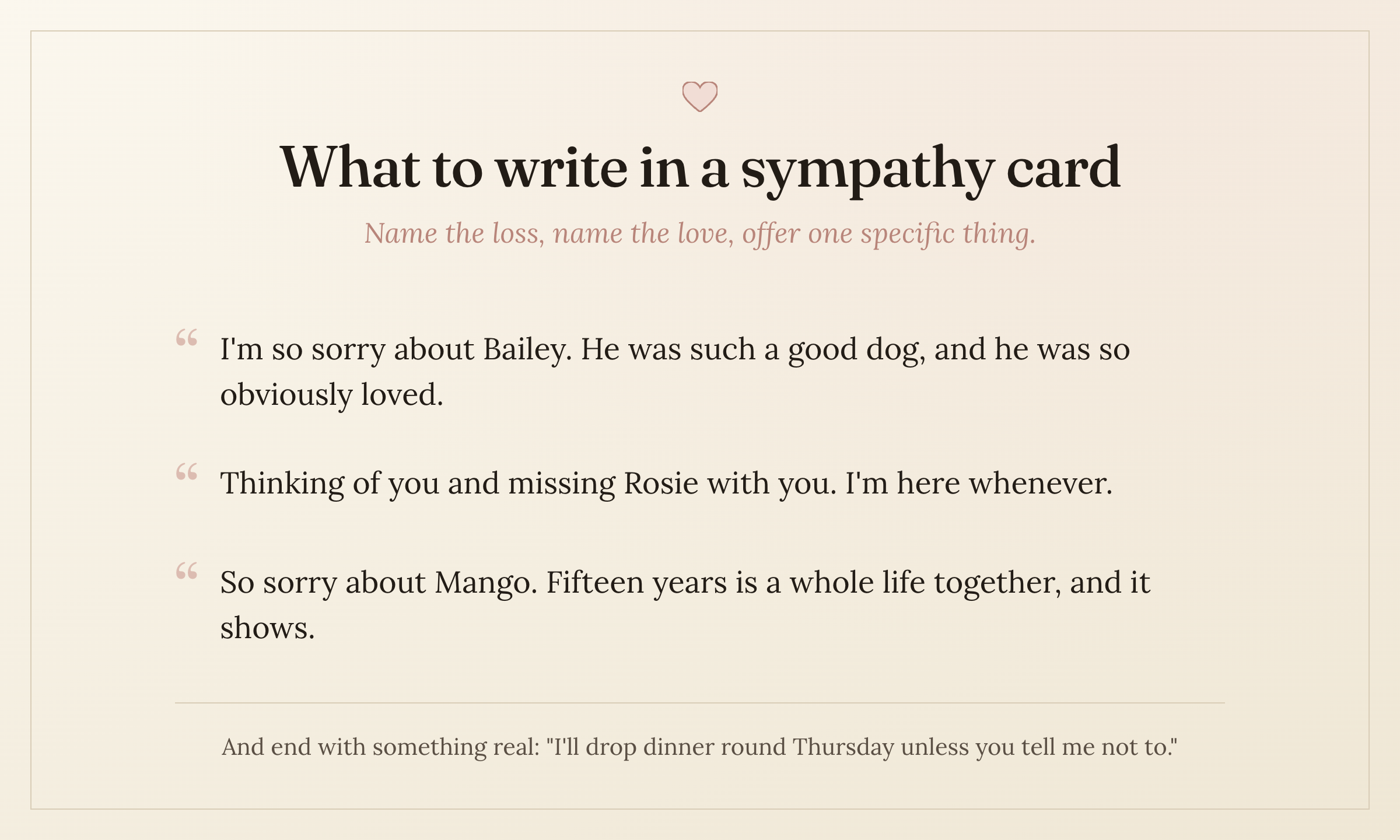
You don't need a perfect sentence. You need three things: name the loss, name the love, offer one specific thing.
If you want to keep it to one line
- "I'm so sorry about Bailey. He was such a good dog, and he was so obviously loved."
- "Thinking of you and missing Rosie with you. I'm here whenever."
- "So sorry about Mango. Fifteen years is a whole life together, and it shows."
If you knew them well
- "I'm so sorry about Bailey. I'll always think of him tearing across the park with that stick that was far too big for him, absolutely delighted with himself. He had such a good life with you, and I know how quiet the house must be. I'll call Sunday — no need to pick up if you don't feel like it."
- "I can't stop thinking about Rosie, and about you. She was the softest animal I've ever met, and she chose you out of everybody. I'm bringing dinner Thursday. You don't have to talk."
If you're signing for a team or a family
The usual failure is thirty signatures and nobody naming the pet. Whoever writes the first line should put the name and one detail in it — "We're all so sorry about Bailey; Sam still talks about the time he stole an entire sandwich" — and then let everyone else sign underneath.
How to end it
Offer one specific, concrete thing rather than an open door. "Let me know if you need anything" is kind, and almost nobody ever takes it up — grief doesn't make phone calls. "I'll drop dinner round Thursday unless you tell me not to" is a real offer, because it happens by default.
If there are children in the family
If the household includes kids, one thing helps more than anything else you might say: use the real word. "Died," not "asleep," not "gone away," not "we lost him." Soft language can leave a young child confused, or waiting for a pet who isn't coming back, or frightened of going to sleep.
That's the short version. If you're the parent, or you're helping one, we've written the full guide separately: helping a child cope with the death of a pet.
The message most people never send
Nearly everyone messages in the first forty-eight hours. Almost nobody messages in week three — and week three is when the house has gone properly quiet, the food bowl is finally put away, and everyone else has gone back to normal.
That's the message to send.
- "I was thinking about Bailey today."
- "Three weeks on. How are you doing, really?"
You don't need a reason or an occasion. Put a reminder in your phone if you'll forget, and put another one on the anniversary next year, and on the day you know was his birthday or his gotcha day. Being remembered a year later, by someone who didn't have to, is one of the kindest things a person can do for a griever.
When you genuinely don't know what to say
Then say that.
- "I don't know what to say. I'm just so sorry, and I love you."
- "There's nothing useful I can say about this, but I didn't want to say nothing."
It's a complete message, and it's honest. Clumsy and present beats polished and absent every single time.
Words are half of it
The rest is showing up. Dropping food off. Walking their other dog, who is also confused. Taking one boring task off their plate without asking permission first. Sitting on the sofa with them without trying to cheer them up, which is harder than it sounds and worth more than anything you can wrap.
Presence is the thing almost everybody wants and almost nobody asks for. If you can give it, give it.
If you want to send something as well
Something small and personal, given a week or two on rather than in the first raw days, tends to land better than anything sent immediately. We've written a fuller guide to that — pet loss sympathy gifts — covering keepsakes, framed photos, donations, and the gifts that aren't objects at all.
If you want one suggestion from it: A Letter from Your Pet ($29) is a short illustrated keepsake written in the pet's own voice, back to the person who loved them. It's the one people most often give after a loss, because it gives the animal one more turn to speak. Two honest notes before you consider it. Ordering asks for a photo of their pet plus a few details about them — favourite spots, small habits, the rituals that were only theirs — which is the sort of thing you'd only know if you knew the animal, so it suits a close friend rather than a colleague. And the illustration is painted from that photo and then finished by hand, so it looks like their dog or cat rather than a stock breed picture. It arrives as a print-ready PDF, hand-finished, within 24–48 hours.
If that's not the right shape for this friendship, the card still is. It nearly always is.
The short version
- Say the pet's name, out loud, more than once.
- Say "I'm so sorry" and stop there if you're stuck.
- Don't start a sentence with "at least."
- Offer one specific thing that happens by default.
- Message again in three weeks, when everyone else has stopped.
You can't fix this, and you were never being asked to. All any of it says is: they were real, you're allowed to be wrecked about it, and you're not doing it on your own.