What to Write in a Pet Sympathy Card, With Examples
You've bought the card. The pen is out, and the inside is blank, or it has a printed verse at the top and a lot of white space underneath.
This page is what to write in a pet sympathy card, one line at a time: examples for a dog, a cat or a smaller animal, for a long life or a short one, and the small decisions a card raises, like the printed verse, a card that's late, or signing from your own pet.
If you need words for a conversation or a text instead, what to say to someone whose pet died covers those. This page is only the card.
Four lines for a pet sympathy card
A sympathy card has room for about four lines, and four is all it needs:
- Their name, and that you're sorry.
- One thing about the animal.
- One line about the two of them, or about your friend.
- A close that asks nothing back.
Here's the whole thing for Lola, a fourteen-year-old dog, written to Ruth and Marcus by Elena from down the street:
Dear Ruth and Marcus,
I'm so sorry about Lola.
I'll miss the way she turned one walk around the block into forty minutes, because every hedge needed checking.
Fourteen years of watching you three go by every evening. It won't look right with just two.
I'll be thinking about you both this week.
With love, Elena
That's the shape. Below, each line in turn, with options for different animals and different losses.
Line one: their name
Open with the pet's name. It's the word your friend will look for first.
- "I'm so sorry about Lola."
- "I was so sad to hear about Cleo."
- "We were so sorry to hear about Nugget."
Write to the people by name: both partners, and the children if they lived with the pet. "Dear Ruth, Marcus and Leo," on the envelope and inside, tells a child the card is partly theirs. There's more on a card just for a child further down.
Line two: one thing about the animal
This line is what makes the card theirs, so make it as specific as you can: a habit, a sound, the place they always were. Moving is optional. Small and true is better.
- For a cat: "I'll miss Cleo answering every question you ever asked her, at length."
- For a rabbit: "I'll always picture Thistle doing her evening laps around the sofa, right on schedule."
- For a guinea pig: "Nugget could hear a bag of lettuce opening from two rooms away, and it made me laugh every single time."
If you never met their pet, skip this line. The next one, about your friend, can carry the card by itself.
Line three: the two of them
Then a line about your friend: what they gave this pet, or what the two of them were together. What fits depends on how the pet died.
After a long life
The Lola card above has one. Another, for a cat:
Sixteen years of the two of you. She claimed the top of your bookcase in the first week and never gave it back.
When it was sudden, or far too soon
If you saw them recently, say so: it tells your friend the news caught you off guard too. If they were young, you can say plainly that it wasn't enough time.
I saw Remy at the park on Saturday, looking exactly like himself. I can't believe it.
Three years wasn't nearly enough time with Remy. I'm so sorry, Tomas.
After a long illness
If your friend spent months caring for a sick pet, say so. The caring filled their days, and that ended too.
You gave Cleo every one of those months: the pills, the appointments, the food warmed up just the way she'd eat it. She was never on her own in it.
When they'd only just found each other
A rescue who had been home a few months is an easy loss to underrate, sometimes even for the owner.
Eight months, and Louie trusted you completely. For a cat who arrived as scared as he did, that's everything.
If they chose euthanasia
Mention it only if they told you, and use the words they used. The card works without it. If you do:
I know how hard last week was. I've thought about you every day since.
Line four: a close that asks nothing back
A card is one-way, so don't end it with a question. "How are you holding up?" and "How did it happen?" both need an answer, and answering is work.
Close with one of these instead:
- "I'll be thinking about you both this week."
- "Otis is lucky to have you, especially now."
Then sign it. "Love" for family and close friends, "With love" or "Thinking of you" for friends, "With sympathy" or "Warmly" for a coworker or a neighbor.
If you looked after their pet
If you were the one who walked the dog, fed the cat, or looked after either while they were away, you knew the animal in a way the owner never quite saw. Write about that. Tell them one thing that happened when they weren't there.
Dear Anna,
Every morning, Bodhi insisted on saying hello to the crossing guard on Hill Street before we could go anywhere. The crossing guard asked about him today. I thought you'd like to know he had friends out there too.
If you have a photo of them from a walk or a visit that your friend has never seen, print it and put it in the card.
If you're writing as a business, write it by hand and sign your own name, not only the business's.
A card just for a child
If a child lived with the pet, a card addressed to them can mean more than a mention in their parents' card. Keep it short, name the pet, say "died" plainly, and pick a memory the child is in.
Dear Leo,
I'm so sorry Lola died. I'll always remember you teaching her to shake hands, and how proud you both looked when she finally got it.
Love, Elena
Leave out where the pet is now. Heaven, the Rainbow Bridge, a better place: the family may have already told the child something, and a card can contradict it. For the parents, there's our guide to helping a child cope with the death of a pet.
When the card already says something
A printed verse
Write under it anyway. The verse can say "sympathy." Only you can say "Lola." Two handwritten lines, their name and something they did, turn a store card into yours. Don't restate the verse in your own words; add what it can't.
A Rainbow Bridge card
Many pet sympathy cards in stores carry the Rainbow Bridge poem, or a picture of it. If your friend has used those words themselves, it can be a comfort. If they haven't, or you're not sure, choose a plain card. A blank one is the safest choice, and it gives you the most room.
Signing from your own pet
It can be lovely when the animals knew each other: "Love, Elena and Pretzel (Lola's walking partner)."
Skip it if the animals never met. When you're not sure, sign alone. And keep paw prints and jokes in your pet's voice for happier cards.
If the card is late
Send it anyway. Nobody counts the days on a sympathy card.
Open with the pet, not the delay. A long apology makes the card about the delay. One sentence is plenty:
I've thought about Remy a lot since you told me, and I didn't want any more time to go by without saying so.
What to leave out
- Questions. On paper, anything they'd have to answer, including "How are you doing?"
- The cause, the cost, or what the vet could have done.
- Your own pet's death, beyond one line. "I remember what the first weeks after Max were like" is kind. A whole paragraph turns the card toward you.
- Anything that needs your tone of voice. A joke can read wrong on paper, and they may read it more than once.
The short version
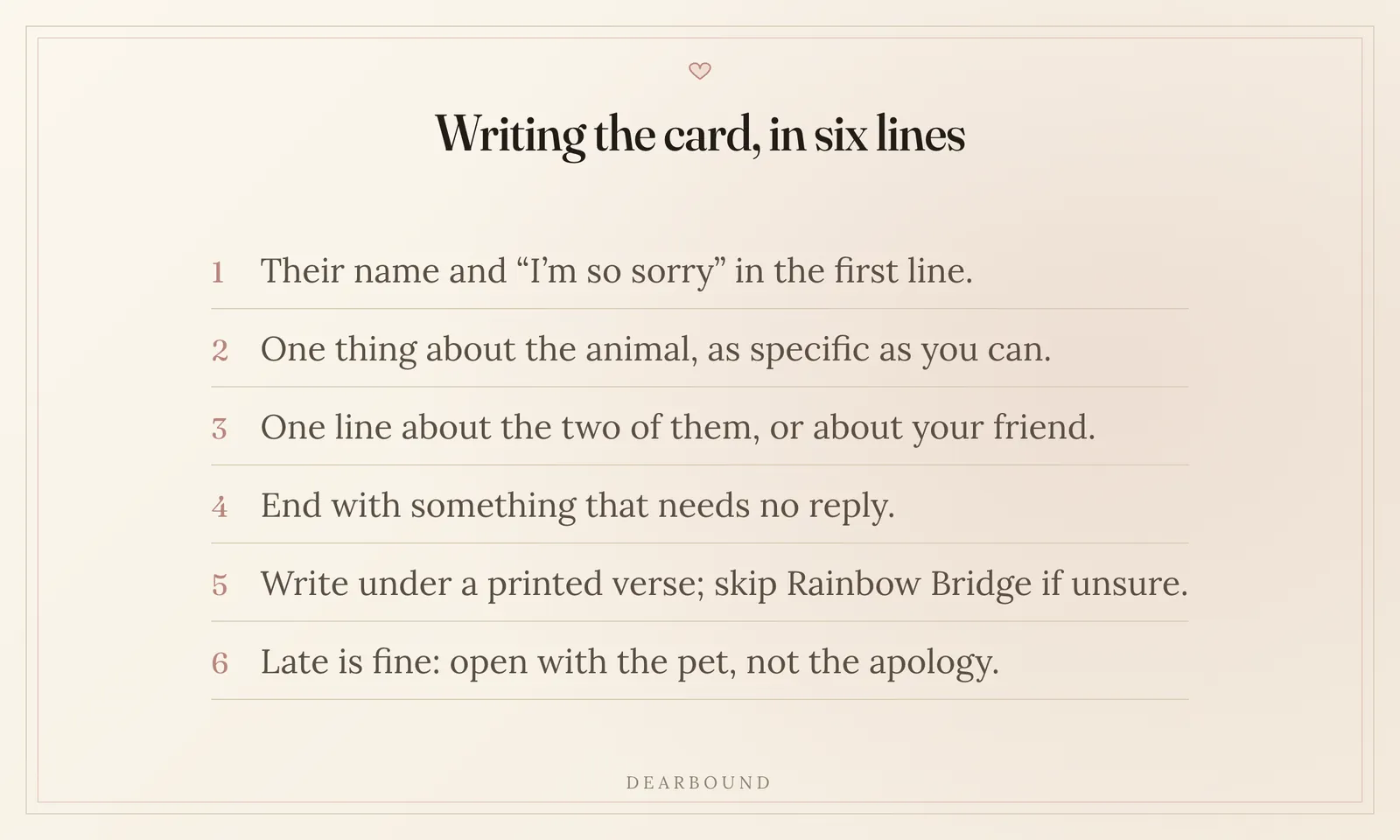
Writing the card, in six lines:
- Their name and "I'm so sorry" in the first line.
- One thing about the animal, as specific as you can.
- One line about the two of them, or about your friend.
- End with something that needs no reply.
- Write under a printed verse; skip Rainbow Bridge if unsure.
- Late is fine: open with the pet, not the apology.
If you're still stuck on the first line, write the name. The rest comes easier after it.
If you'd like to give something too
If something should go with the card, our guide to pet sympathy gifts sorts the options by how close you are. For a close friend whose pet you knew well, A Letter from Your Pet is a letter written as if from their pet and addressed to your friend, with their pet's portrait, painted from a photo you send and finished by hand. You answer the questions about the pet's habits and rituals yourself, and you choose where the letter says they are now, including "kept in memory and presence," which keeps belief out of it if you're not sure. It's a PDF, sent to your email within 24–48 hours for you to print, on cardstock if you can; nothing is mailed.