How to Write a Dog Eulogy (or a Cat's), With Examples
Someone has to say a few words, and everyone is looking at you.
Maybe it's the corner of the garden where they'll be buried, or the kitchen table the night the ashes came home. A handful of people who loved this animal, standing close, waiting for someone to start. A dog eulogy (or a cat's) can be two minutes long and plainly said. What matters is that it sounds like them, and that you reach the end of it.
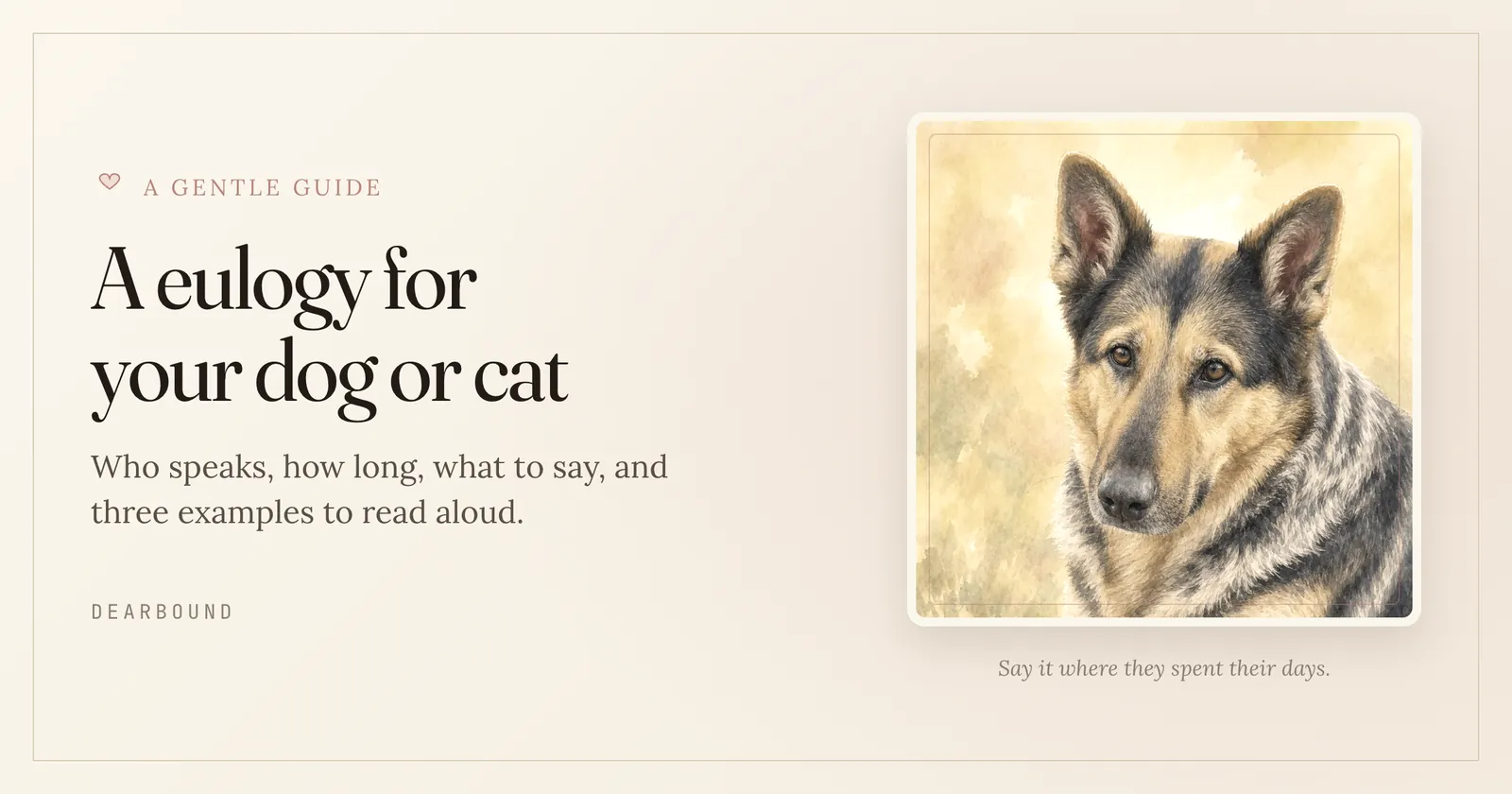
Below: who speaks, how long to go on, what to say so it works out loud, what to do if your voice goes, and three examples written to be read aloud.
The written version, the few lines that tell people who weren't there, is an obituary, and the pet obituary guide covers it. Here we stay with the words you say out loud.
A dog eulogy is for people who already know
An obituary tells people the news. A eulogy doesn't have to. Everyone listening already knows your pet died, and most of them knew your pet. That changes the job.
You don't need dates, a breed, how long they were ill or who they leave behind. You need to give the people in that room a minute with the animal they're missing: the play sneeze whenever someone said "beach," the way they backed into every room, the one thing they did that no other animal ever did.
So with the blank page in front of you, picture the faces that will be looking back, and write to them.
Decide three things before you write
Who speaks
One person can say all of it. That's the most common shape, and the easiest to plan.
The other good shape is a round. One person opens with a sentence or two, everyone else says one thing they'll miss, and the opener closes. It takes the weight off any single voice, and it lets a child or a quiet uncle say a single line without having to give a speech. There's an example of a round further down this page.
Whichever you choose, ask people before the day, not in front of everyone. "Would you like to say something about Rooney on Saturday? One line is plenty" is easy to say yes or no to. Being asked on the spot is not.
How long
Shorter than you think. Two minutes is plenty for one speaker. A round can run longer, because each turn is short.
The only way to know is to time it. Read it aloud at speaking pace, with your phone's stopwatch running. If it goes past three minutes, cut a whole story rather than trimming a sentence from every part. One story with room to breathe does more than four squeezed in.
Where and when
There's no deadline. You can say it at the burial, the same day. You can wait until the ashes come home, or pick a Sunday a week later, when everyone can be there. All of those are fine.
The place matters more than the timing. Say it somewhere they spent their days: the patch of lawn by the gate, their end of the couch, the trail you walked every evening. If someone who loved them can't come, call them on video and stand the phone where they can see.
What to say, in four parts
Keep them in this order, and keep each one short.
Why you're there
One plain sentence. It gives everyone, you included, a second to settle.
We're here to say goodbye to Maple, and to say thank you.
Their job in the house
Every pet has a job in a family, even if nobody gave it to them. The one who meets the school bus. The one who supervises every bath. The one who herds everyone upstairs at night. Say what their job was, and how seriously they took it.
For eleven years, Maple's job was the school bus. Every afternoon at twenty to four she was at the end of the driveway, and she kept going long after the kids stopped riding it.
One story the room will recognize
Pick a story the people listening were part of, or have heard you tell. When the room recognizes it, people laugh, and laughter at a pet's eulogy is a good sign. It means, for a second, they're there.
Tell it the way you'd tell it at dinner, not the way you'd write it. Say their name more often than you would on paper, because "he" and "she" get lost when people are crying.
A few words to them
Here's where a eulogy parts ways with anything written for others to read. At the end, turn from the room to them, and switch from "he" or "she" to "you." Thank them for one specific thing. A single sentence will do.
Maple, thank you for every afternoon at the end of the driveway. You can stop waiting now. We're all here.
How they died doesn't need a sentence at all; everyone in that circle already knows. But if one person stayed with them through the last of it, thank that person by name. It can mean more to the room than the rest of the eulogy.
Joe was with her at the end. Thank you, Joe.
Write it to be heard
A eulogy is written for the ear. A few things help.
- Print it. Big type, one sentence per line, space between them. A phone screen dims or locks halfway through, usually at the worst moment. If you have to read from your phone, set it not to lock before you start.
- Split the long sentences. When you time it, you'll hear the ones you can't say in one breath. Break each one in two.
- Mark the hard line. You probably already know which sentence will be difficult. Put a small mark before it, and plan to stop there for one breath.
- Give someone a second copy. Agree on a signal: if you hand them your page, they pick up at the next line. You may never need it. Knowing it's there is the point.
If your voice goes
It might. That isn't a failure, and nobody listening will think it is.
Stop. Look down at the page. Take one slow breath, then read the next line, not the one you lost. If it still won't come, hand the page over; that's what the second copy is for.
And if no one can finish it, it's all right to say "We'll finish this later" and let the quiet do the rest. The people in that circle understood what you meant three sentences ago.
If there are children
A child doesn't have to speak, and shouldn't be asked to on the spot. Ask beforehand what they'd like to do: say one thing, hold the photo, choose where the photo goes afterward, or just stand next to you. All of those count as taking part.
If a child does want to say something, let them go first. Waiting for their turn while the adults around them cry is harder than speaking.
We have a longer guide to helping a child cope with the death of a pet, for the days after.
Three examples to read aloud
Each one is written to be said, not read: short sentences, the name said often, and a few words to them at the end. Swap in your own animal and keep the order.
For a dog, said by one person
We're here to say goodbye to Maple, and to say thank you.
For eleven years, Maple's job was the school bus. Every afternoon at twenty to four she was at the end of the driveway, ears up, tail going. She kept doing it after Lucy and Eli stopped riding the bus. She kept doing it after they left for college. Some afternoons she was the only one who remembered what time it was.
Most of you know the story of the lake. Maple saw a goose. Maple went in. Maple came out twenty minutes later, without the goose and very pleased with herself, and Joe drove home with every window down.
She went gray around the face these last few years, and slow to get up, and she still got up for the bus.
Joe was with her at the end, on Thursday. Thank you, Joe.
Maple, thank you for every afternoon at the end of the driveway. You can stop waiting now. We're all here.
For a cat, short
We're here for Pilot.
Pilot drank from the bathroom faucet, and nowhere else. Someone had to turn it on for him, to a thin trickle, and wait. For twelve years, one of us stood at that sink every morning at six, half asleep, until a cat was finished.
He also unpacked the groceries. Every bag, every time, one item at a time, with his whole head inside. He never found anything he wanted. He checked anyway.
Bonnie says she'll keep running the faucet for a while. We might all do that.
Pilot, thank you for the six o'clock mornings. We didn't mind them. Not really.
A round, for a family
Kim: We're here for Rooney. Everyone says one thing they'll miss. Nico, you go first.
Nico, 6: She listened to me practice the recorder every day, and she only left the room twice.
Grandpa Lou, on the phone: She brought me her leash every time I came over, and I never once took her for a walk.
Ellie: The big sigh she let out every time she lay down, like she'd had the longest day of anyone.
Kim: Rooney, you were a very good dog for fourteen years. Thank you for all of it.
Afterward, keep the page
Once it's said, a eulogy is gone, unless someone kept it. Keep the printed page. Fold it into the photo album, or put it in the drawer with their collar. If someone filmed it on a phone for family who couldn't be there, ask them to send you the file.
A eulogy is said once, standing up, to the people who came. If the part you keep going back to is the last part, the words you said to them, A Letter to Your Pet puts that on paper: a six-page letter, signed by you, built from your answers, among them the ritual you shared and the places that were theirs. The portrait is painted from your photo and finished by hand, and the letter comes as a print-ready PDF within 24 to 48 hours. Printed on cardstock, it goes in a frame.
If what you said on the day was enough, keep the page and let that be it.
The short version
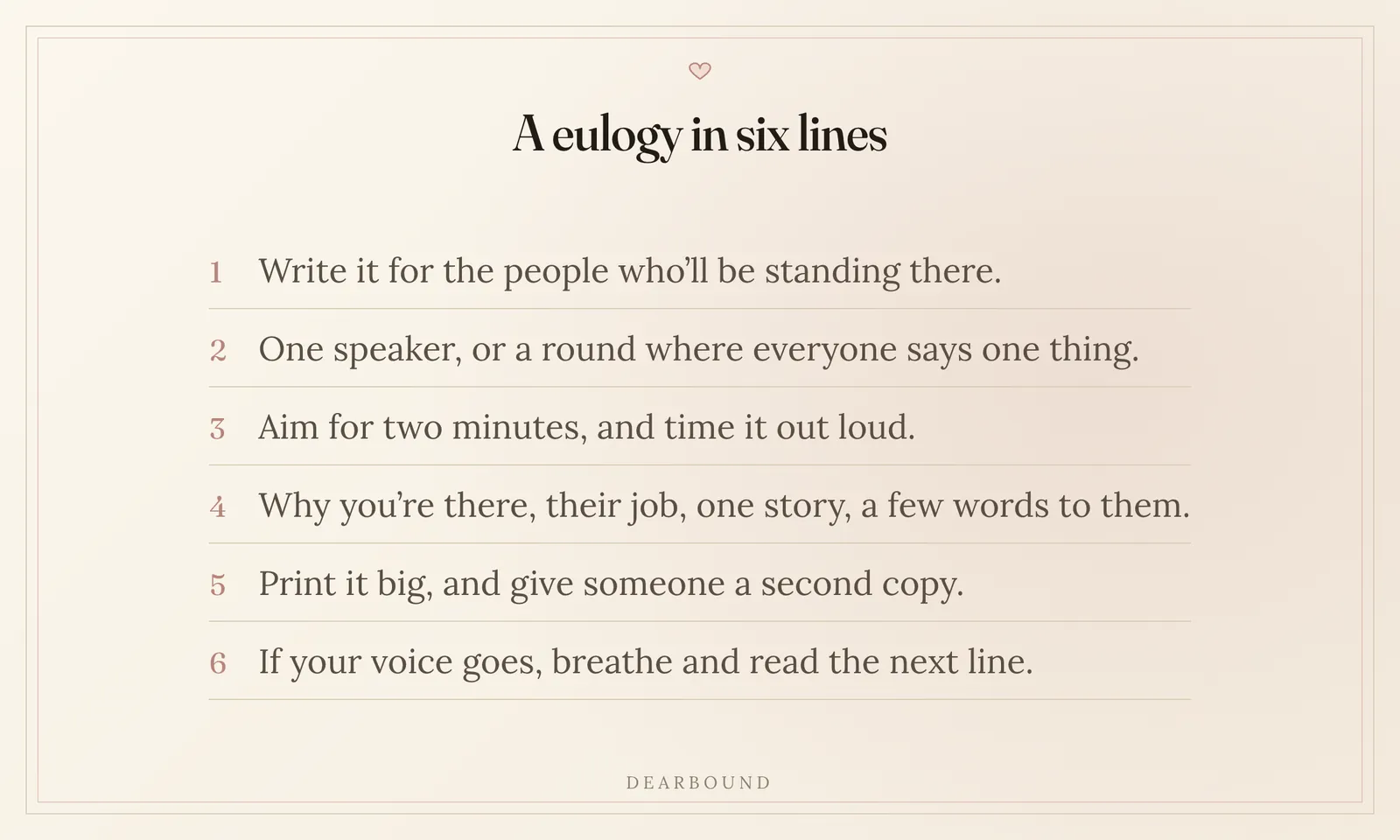
A eulogy in six lines:
- Write it for the people who'll be standing there.
- One speaker, or a round where everyone says one thing.
- Aim for two minutes, and time it out loud.
- Why you're there, their job, one story, a few words to them.
- Print it big, and give someone a second copy.
- If your voice goes, breathe and read the next line.
If you only manage one sentence tonight, make it the one about their job. The rest of the eulogy can hang off it.