How to Announce Your New Pet: What to Say, With Examples
They're home.
Maybe it was a shelter on a Saturday morning, or a breeder you'd been emailing since spring, or a cat who turned up on the porch and simply never left. However it happened, there's a new animal asleep somewhere in your house, and everyone you know wants to see them.
The usual announcement ideas are about props: the letter board, the puppy in a basket, the matching bandana. This page is about the words. What to actually say in the caption, the post, the family group chat and the holiday card, for the situation you're really in, with examples you can adapt.
Two things before you start. You don't have to announce at all: a text to the handful of people who'll care is a complete announcement too. And you don't have to do it on the first day. They'll still be new next week.
Start with three things
Every good announcement, short or long, is built from the same three things.
Their name, and the nickname that's already forming. If the name isn't settled yet, say so. It's a better first line than most names.
Name pending. Currently answering to "hey" and "no."
How you found each other, in one sentence. A shelter, a rescue, a breeder, a friend's litter, the cat on the porch. Every one of those is a good start to a story, and none of them needs explaining.
One true thing you've already noticed. Not "so cute"; everyone can see that from the photo. The first habit: where they've decided to sleep, the noise they make at the door, the thing they've already stolen.
Put the three together and you have a whole announcement:
This is Juniper. We met her at the county shelter on Saturday, and by Sunday she had claimed the left side of the couch.
Pick the length for the place
The same three things stretch or shrink to fit wherever you're putting them. These are the four lengths you're most likely to need.
The one line
For the photo caption, the letter board, the text to your mom. A name and one true thing, nothing else.
Meet Miso. Nine weeks old, and already asleep in the laundry basket.
Juniper. Three years old. Home.
The short post
For social media or the family group chat: three or four sentences and one good photo. Here's the Juniper line from above, grown into a post:
Everyone, meet Juniper. She's three, she's mostly shepherd (we think), and she came home with us from the county shelter on Saturday. By Sunday she had claimed the left side of the couch and worked out which of us drops the most toast. Thank you to everyone at the shelter who looked after her. More photos than you asked for are coming.
A few decisions, a sentence each:
- Friends only, or public? If you're not sure, start with friends only. You can always share it wider later.
- One good photo beats the whole camera roll. Their face, in decent light, looking like themselves, rather than the adoption paperwork on the kitchen table.
- Text the closest people first. Anyone who'd want to hear it from you, like the friend who drove you to the shelter, gets a message before the post goes up.
- Tag the shelter, rescue or breeder if you'd like to. It's a nice way to say thank you in public.
The holiday card line
If they arrived this year, the end-of-year card is a natural place to introduce them to the people who never see your posts: the great-aunt, the old neighbors, the college roommate. One line under the family's names does it, or a short P.S.
This year there's one more name on the card. Meet Juniper, who joined us in August and has slept under the tree since the day it went up.
New this year: Miso. Small, loud, and very interested in the ribbon.
P.S. The dog in the photo is not a guest. His name is Waffle, and he lives here now.
If you'd rather sign the whole card from the new arrival, with a paw print and a line in their voice, we wrote a separate page on what to write in a card from your pet.
The longer version
For the email to the grandparents, the friend who lives abroad, or the post where you want to tell the whole story. A paragraph or two is plenty: the day you met, the drive home, the first night.
We weren't planning to come home with anyone. We went to the shelter "just to look," and we were wrong about that. Juniper was in the last kennel on the left with her chin on her paws, and she was the only dog in the room who didn't bark. She shook the whole drive home. The first night she slept in the hallway, exactly halfway between our bedroom door and the front door, as if she hadn't made up her mind yet. By the end of the week she had.
Write this one down even if you never send it. The details of the first week blur faster than you'd expect, and this is the version you'll be glad to have.
What to say, by situation
The three things work for every animal and every route home. What changes is the tone, and sometimes what you choose to leave out.
A puppy or a kitten
The easy one. Everyone already wants to see them, so lean into the smallness and the chaos. Save the sleep-deprivation jokes for your friends; in a public post they can sound like you're complaining about your own good news.
Waffle came home today. He's eight weeks old, roughly the size of a loaf of bread, and he fell asleep before we were out of the driveway.
Waffle has lived here for four days and has already eaten a corner of the doormat. We regret nothing.
An adult or a senior pet
Say their age proudly, not apologetically. An older animal coming home is good news in its own right, and the post doesn't need to explain why you chose them.
Meet Walter. He's ten, he's a gentleman, and he waited a long time for a couch. It's his now.
Dot is seven, very calm, and an expert at lying on feet. We got lucky.
Leave out any arithmetic about how many years they might have. Today's post is about the couch.
A rescue with a history
This is the hard one. Their past is their story, and you get to decide how much of it goes public. There are three honest ways to handle it.
Nothing about before.
Juniper is home. That's the part of the story we're telling.
A little.
She spent a few months at the shelter waiting for the right people. Apparently that's us.
Plainly, with care. One sentence that names it without the details, then straight back to who they are now.
Juniper had a hard start before she reached the shelter. She's safe now, and she's very, very spoiled.
Any of the three is a complete announcement. Whichever you choose, the worst details can stay with you and the people who need to know them.
If someone looked after them before you did, a thank-you is a kind line to add. Name the shelter, the rescue or the foster family if you'd like to.
Thank you to everyone at the shelter who kept her safe until we got there, and to her foster family, who taught her that sofas are allowed.
A foster fail
The funniest announcement on the list. Own it completely.
We said we'd foster. We were lying.
Update on the foster dog: he's not a foster dog anymore. He's ours, and frankly he knew before we did.
A cat
A cat announcement can be dry. The cat would want it that way. Here's a full one:
Please welcome Pearl. She's eleven, she came home from the shelter on Tuesday, and she spent her first full day under the guest bed, reviewing her options. As of this morning she has accepted the position of household cat, on the condition that breakfast is served at six. We have agreed to her terms.
And for a kitten, the one-liner from earlier does the job: Meet Miso. Nine weeks old, and already asleep in the laundry basket.
A rabbit, a bird, or a small pet
Same three things, smaller world.
Meet Fig. She's a rabbit, she does a little twisting jump when she's happy, and she has done it four times since lunch.
Say hello to Sunny. She's a budgie, she's mostly yellow, and she sings along with the washing machine.
When you already have pets
The animal who was there first is half the story. Let them be funny about it, and don't promise in the post that the two of them will be best friends. That's a story for a later update.
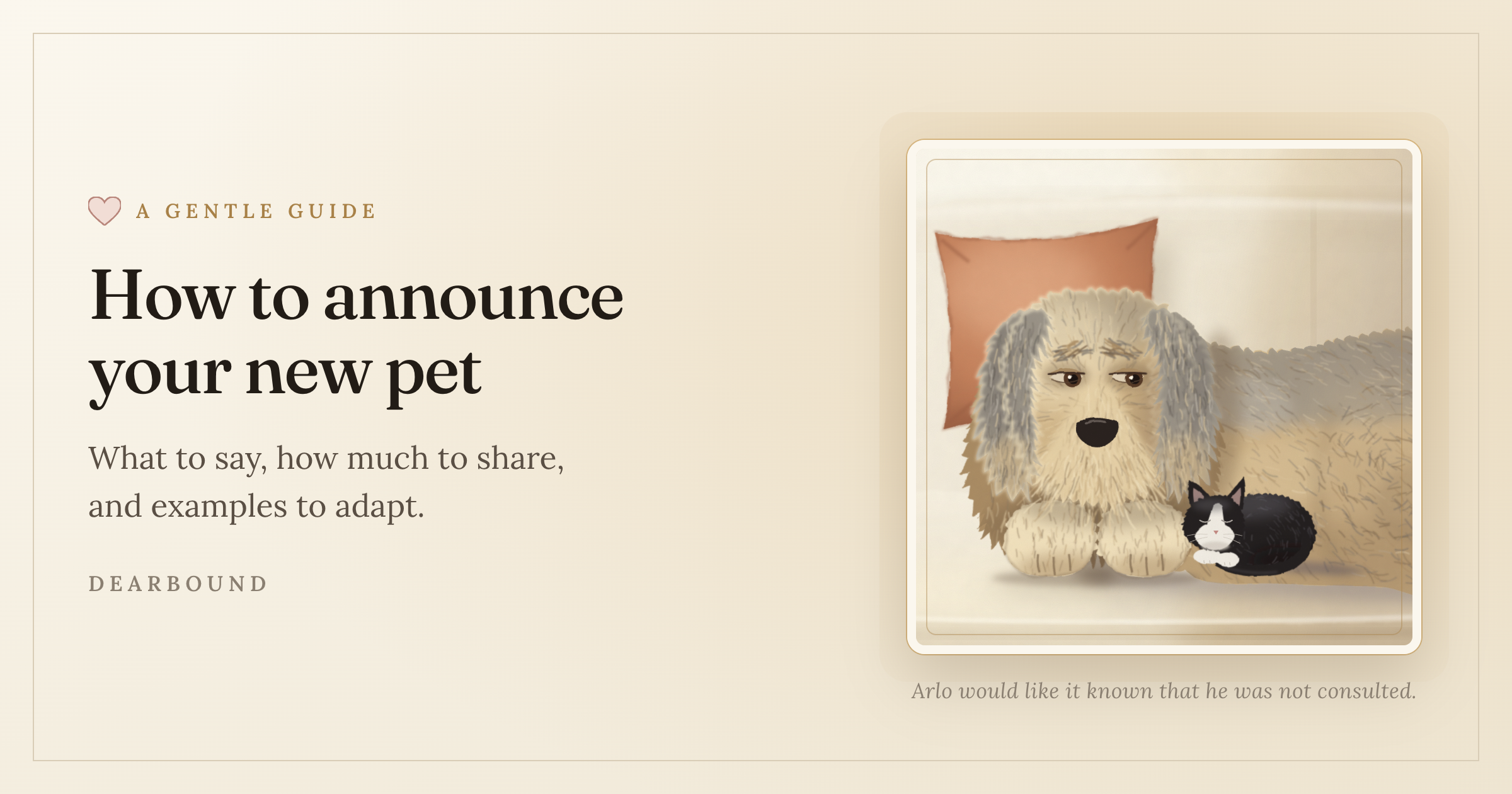
Arlo would like it known that he was not consulted.
Arlo has been told about the kitten. Arlo has not responded.
When it's a child's pet
Let the child write it, and leave it uncorrected. Or let them dictate the message to the grandparents, word for word.
From Nell, age 8: He is called Moss and he is mine and also a little bit Mom's.
Nothing you write will beat that, so don't try.
After a pet who died
This announcement carries two animals: the one who has just arrived, and the one who isn't here to meet them.
You can name the one who died, or not. Both are honest. If you do, the people who loved them too will be glad to see the name.
Then write about the new one the way you would about any new arrival: their name, how you found each other, one true thing about them. Their story starts here, and it gets its own sentences.
Two years after we said goodbye to Hank, there's a dog in the house again. This is Moss.
Hank would have pretended not to like him. Welcome home, Moss.
You don't owe anyone a timeline. If someone replies "already?", one line answers it, and you don't have to send even that.
We'll always miss Hank. We're also very glad Moss is here.
What to leave out
The pun stack. One pun, if it's genuinely yours, is charming. Five in a row reads like a template, and your animal disappears behind it. If you love puns, keep your best one. Just the one.
The paperwork. Adoption contracts, registration papers and vet records can show your full name and home address. Crop them out of the photo, or leave them out of the picture altogether.
Their worst day. The intake photo, the "before" picture, the story of exactly how they were found. A before-and-after can feel like a happy ending, but the "before" is their hardest moment, posted for strangers. Lead with the after.
The debate. Shelter, rescue, breeder, a friend's litter, a cat who turned up on the porch: every one of those is a good first line. Leave out the slogan, whichever side it's on, and you don't owe the comments a defense of how your pet came home.
When the replies come in
The same three questions will arrive forty times: what's their name, what breed are they, when can we meet them. You don't have to answer each one. One reply, or a comment under your own post, covers everyone.
Answering everyone at once: she's a mix of something and something else, she's three, and yes, you can meet her soon.
If people ask to come over and you're not ready for visitors yet, "not yet, but soon" is a whole answer. You don't need to give a reason.
And if you've landed here from the other side, because a friend just brought a pet home and you're trying to write back, that's a different page: what to write in a new pet card.
If you want the longer version
An announcement is the short version: a few lines for other people, posted and done. Some people want the long version too, kept for themselves: the whole story of the day they came home, told properly.
That's what Welcome Home is. It's a personalized illustrated storybook that follows the same beats as the longer announcement above: the quiet house before they came, the day you found each other, the drive home, the first night, learning each other, and the day they were simply yours. After checkout you answer a few questions (their name, how they look, who they came home to, their favorite thing in the world and where they love to sleep, plus, if you like, the day you brought them home and a quirk that's all theirs) and upload one photo. An optional question asks where they came from, and the page about how you found each other is written to match: a shelter, a rescue, a breeder, a stray who found you, or however else you met. There's a version for a senior pet who waited a long time for a home, too.
Its eight illustrations are painted from your photo and finished by hand, so the animal on every page is yours. It's $29, delivered as a digital, print-ready PDF within 24 to 48 hours. If you're choosing between photos, we wrote a guide to picking the best photo for a pet portrait.
If your newest family member arrived this year, it can also be a present at home for the holidays: for the kids, or from one partner to the other. It's a PDF, so there's no shipping date to race.
If you've already posted the announcement, you don't need anything else. The few true lines you wrote for everyone else were the important part.
The short version
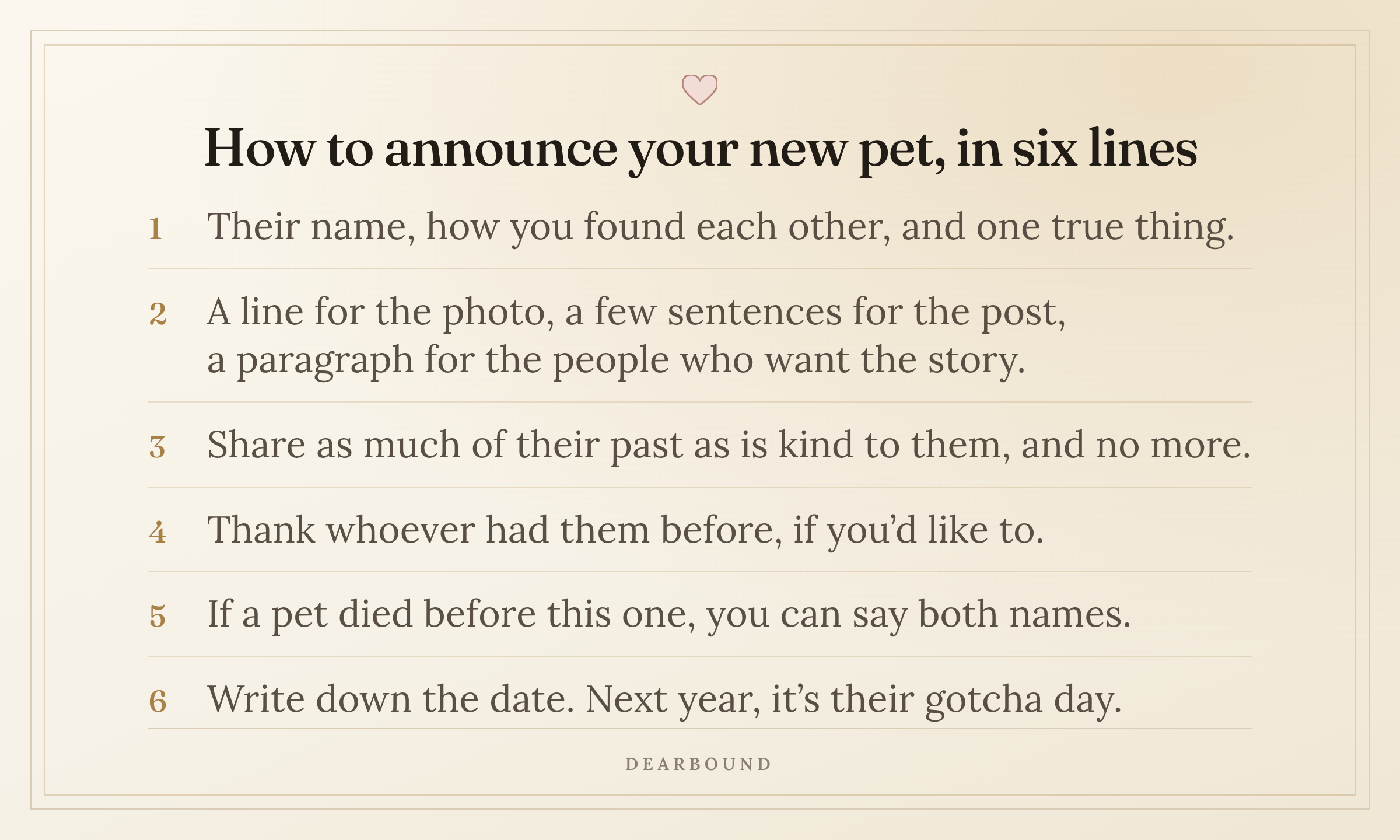
How to announce your new pet, in six lines:
- Their name, how you found each other, and one true thing.
- A line for the photo, a few sentences for the post, a paragraph for the people who want the story.
- Share as much of their past as is kind to them, and no more.
- Thank whoever had them before, if you'd like to.
- If a pet died before this one, you can say both names.
- Write down the date. Next year, it's their gotcha day.
That last line matters more than it looks. A year from now it's their gotcha day, and we've written a whole page of ways to mark it.
None of this has to be clever. Their name, where they came from, and the first small thing you noticed about them: that's an announcement. Everything else is just more photos.