The Best Photo for a Pet Portrait: How to Choose or Take One
You've decided to have them painted. Or you're most of the way there — and now you're four thousand photos deep in your camera roll trying to work out which one is the one.
Here's the thing that makes this much easier: the best photo to paint from is almost never the prettiest photo. It's the clearest one. That gorgeous shot of them on the beach at sunset is a lovely photograph and a nearly useless reference, because there's no face in it. The slightly boring one from last Tuesday, where they're sitting in the kitchen window light looking straight at you, is the one.
This is a guide to spotting the difference: what to look for, how to take a better photo in about ten minutes if your pet is asleep three feet away right now, and what to do if the photos you already have are the only ones you'll ever get.
What makes a photo good to paint from
Start here, because it's the whole principle: an illustration can only contain what the photo contains. If a detail isn't visible — the exact grey coming in on the muzzle, the notch in one ear — there's nothing honest to paint it from.
So you're not looking for a good photograph. You're looking for a photo with a lot of them in it. Five things do most of the work.
Their eyes are clear
The likeness lives in the eyes more than anywhere else. You want them sharp, open, and catching a little light. If the eyes are soft or motion-blurred, nothing else in the frame rescues it — not the pose, not the light, not the composition.
Check this first. It rules out more photos than everything else combined.
Soft daylight, not harsh sun or lamplight
Beside a window, outside in open shade, or on an overcast day. Those three are the whole answer.
What to avoid is direct midday sun, which blows white and cream fur out into a flat shape and carves hard black shadows across the face — and indoor lamplight, which shifts color warm. That's why your grey cat keeps photographing beige.
Taken at their level
Hold the phone at their eye height rather than shooting down from standing. Photographing downward foreshortens the body and flattens the face, and it's the most common reason a finished portrait doesn't quite look like them, even when nobody can say exactly why.
Kneel, sit on the floor, or just set the phone on the ground and tilt it up.
You can see what makes them them
The white flash on the chest. The one ear that folds. The freckle on the nose. The grey coming in around the mouth. The cowlick, the notch, the one odd-colored toe.
Those specifics are the entire difference between a portrait of your pet and a generic breed picture. They have to be visible in the photo to make it onto the page.
They fill most of the frame
Close enough to see the detail, but taken from about an arm's length or a little further rather than right up against them. Phone lenses stretch whatever is nearest, which on a dog or a cat is almost always the nose.
The quick test
Here's the sixty-second version of everything above.
Look at the photo small — on your phone, held at arm's length, no zooming. If you can still tell instantly that it's them, from the shape and the markings and the expression, it's a good photo to paint from. If you have to zoom in to be sure, it isn't.
That's the test. Most of the rest of this page is just a longer way of saying it.
How to take a good one in ten minutes
If your pet is asleep somewhere nearby right now, you can beat anything in your camera roll in about ten minutes. No equipment, no skill assumed.
Wipe the lens
First, because it takes two seconds and it's the highest-return thing on this entire page. Phone lenses live in pockets. Half of the "my phone takes soft photos" problem is a smear of something.
Put them near a window
Light does most of the work. Face them toward the window rather than having it behind them — a backlit pet is a silhouette, and there's no likeness in a silhouette.
Turn the room lights off while you're at it. Mixing lamplight with daylight muddies their color.
Get down to their level
Floor, sofa, wherever they are. This is the difference between a photo of a pet and a photo of the top of a pet.
Make the noise once, right at the end
You get roughly one good second of attention per noise. So set everything up first — light, angle, framing — and then squeak the toy, say their name, or crinkle the treat bag.
Spending your best noise while you're still finding the angle is how people end up with forty photographs of a bored animal.
Shoot a burst, choose later
Hold the shutter down and take thirty. Then pick the frame with the sharpest eyes, not the cutest head tilt. Those are rarely the same photo, and the eyes win.
Ignore the background
Genuinely. For an illustrated portrait the background is painted fresh anyway, so the messy sofa or the cluttered counter behind them isn't a problem. Spend that effort on the light and the angle instead.
If your pet is black, or very dark
This one deserves its own section, because a dark coat swallows light and most phone cameras respond by giving up.
- Bright, but indirect. Open shade, an overcast day, or right beside a window. Never a dim room, and never the on-camera flash — flash flattens a dark coat into one solid black shape and turns the eyes into two discs.
- Use a lighter background. Put them against something mid-toned so the edge of them separates from what's behind, instead of dissolving into it.
- Tap their face on the screen. That sets the exposure on them rather than on the bright window behind them. If your camera lets you nudge the brightness up a notch, do it — slightly too bright is recoverable, and a silhouette isn't.
- Then check for detail. Can you see where the nose ends and the cheek begins? Is there variation in the black — the brown in the coat, the lighter fur around the mouth? A dark pet photographed badly is a shape, and there's no likeness in a shape.
The mirror image of this problem is a white or cream pet in full sun, which blows out into a featureless patch. Same fix: softer, indirect light.
The words matter too
One thing worth knowing before you go hunting: when you order, you also describe them in a line or two. Something like "bright ginger tabby with amber eyes and a white chin."
That isn't a formality. It does real work, because it covers what a photograph can't:
- The grey that came in after your favorite photo was taken.
- The color a warm kitchen light quietly distorted.
- The marking the angle happened to hide.
So if the photo and the truth disagree, say so in words. A decent photo plus a specific description beats a perfect photo on its own.
If the photos you have are all you'll ever have
If your pet died, then you have the photos you have, and there won't be any more. There's no gentle way around that sentence, so here it is plainly — and then let me be useful.
The photo doesn't have to be technically good. It has to contain them. A slightly grainy phone snap where they're looking straight at you is worth more than a beautifully composed one taken from above. The grain doesn't matter much. The angle does.
A still from a video counts, too. Scrub through to a frame where they're looking toward the camera and screenshot it. It's lower quality than a photograph, and it's often the only frame where they look like themselves.
It's also worth asking family and friends to send you whatever is on their phones. People routinely turn up photos of their own pet they had never seen — taken by someone else, at someone else's house, on an ordinary afternoon.
And if you're torn between two, choose the one that looks like their personality, not their best angle.
If you're in that season, there are other gentle ways to hold onto them as well. We wrote about how to memorialize a pet who died with the same care.
What you don't need to worry about
Most of what stops people here is a worry that turns out not to be real. To clear a few:
- You don't need a real camera. A phone photo in good light beats an expensive camera in a dark room, every time.
- You don't need a perfect pose. Sitting, lying down, mid-yawn, head tilted — all fine.
- You don't need a tidy background. See above.
- A photo with people in it is fine. We paint the pet. In a portrait collection your pet is alone in every image; in the illustrated books, any people are drawn as playful, stylized characters, never a likeness of a specific person.
- You don't need to send ten photos. One good one is what the whole thing is built on.
And if your pet is still here and getting older, take the photo now, while you can still choose the light. That's a big part of what we mean by making the most of time with a senior pet.
What happens to your photo
Once you've picked one, here's the honest version of what happens next. Each portrait is painted from your photo — their real coat, their real markings, their real face — and then finished by hand before it reaches you. Never a generic breed picture pulled off a list.
The smallest way to see that for yourself is Portraits of Your Pet, at $15. It turns that one photo into eight painted portraits: a hero cover portrait plus seven themed scenes. You choose the world they're painted into — Cozy Home, Garden & Seasons, Adventure, or Quiet Remembrance, which is warm golden light, for a pet who has died. It arrives as a digital, print-ready PDF plus each portrait as its own image, so you can print or frame them one at a time, hand-finished within 24–48 hours.
The same single photo is all any of our illustrated books need, too.
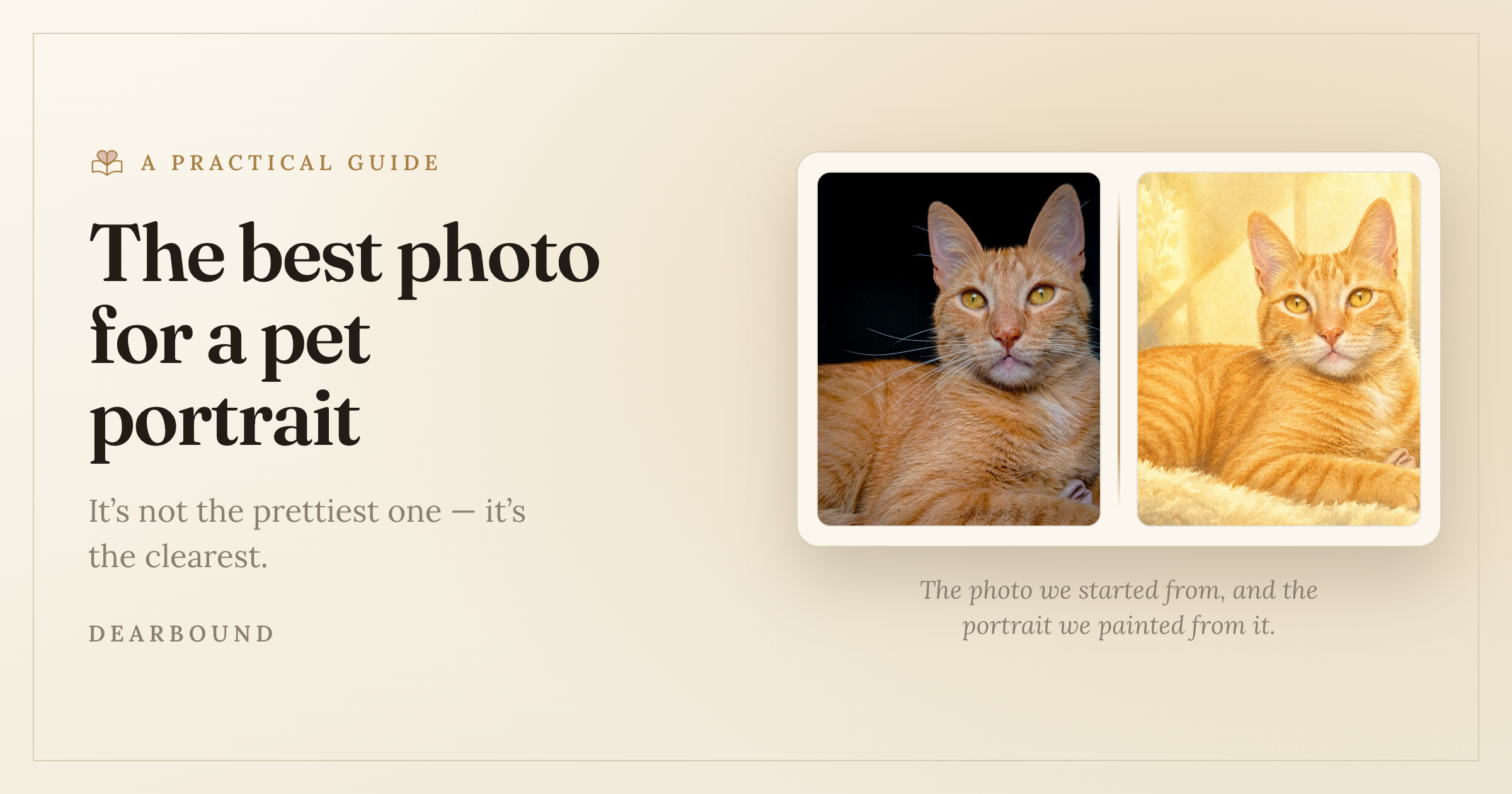
And you don't have to take our word for the likeness. Every sample on our site shows the photo we started from, right beside the pages we painted from it. Go and look at one, and judge it yourself.
A quick checklist before you upload
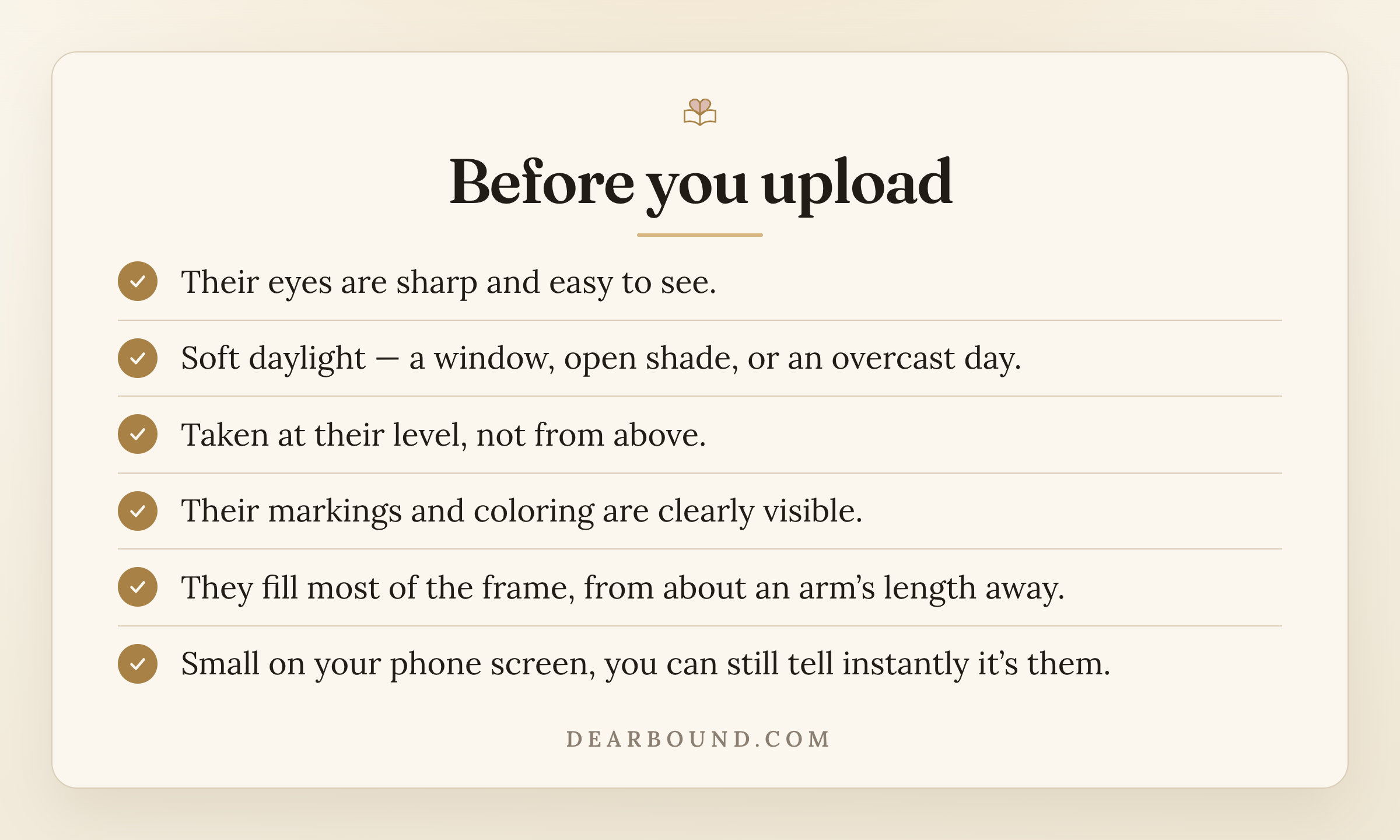
- Their eyes are sharp and easy to see.
- Soft daylight — a window, open shade, or an overcast day.
- Taken at their level, not from above.
- Their markings and coloring are clearly visible.
- They fill most of the frame, from about an arm's length away.
- Small on your phone screen, you can still tell instantly it's them.
The photo you're looking for is probably already on your phone. It's usually the ordinary one, taken on an ordinary day, where they happened to look right at you — and that's almost always the one that looks the most like them.