Preparing Your Pet for a New Baby: A Gentle, Practical Guide
Before the baby, there was your pet. They were the one who curled up next to you on the hard days, the one who greeted you like you'd been gone a year every time you walked through the door. In a lot of ways, they were your first baby. And now the family's growing.
If you're reading this, you're probably not worried about whether it's safe — you already know your pet, and you know they're gentle. What you're actually worried about is quieter than that: you don't want them to feel pushed aside. You don't want the animal who has loved you so completely to spend the next months wondering what they did wrong.
Good news: getting a pet ready for a baby isn't about training the love out of them. It's about making room — slowly, kindly — so that when the baby arrives, everyone (your pet included) still feels like they belong. Here's how to do that, one calm step at a time.
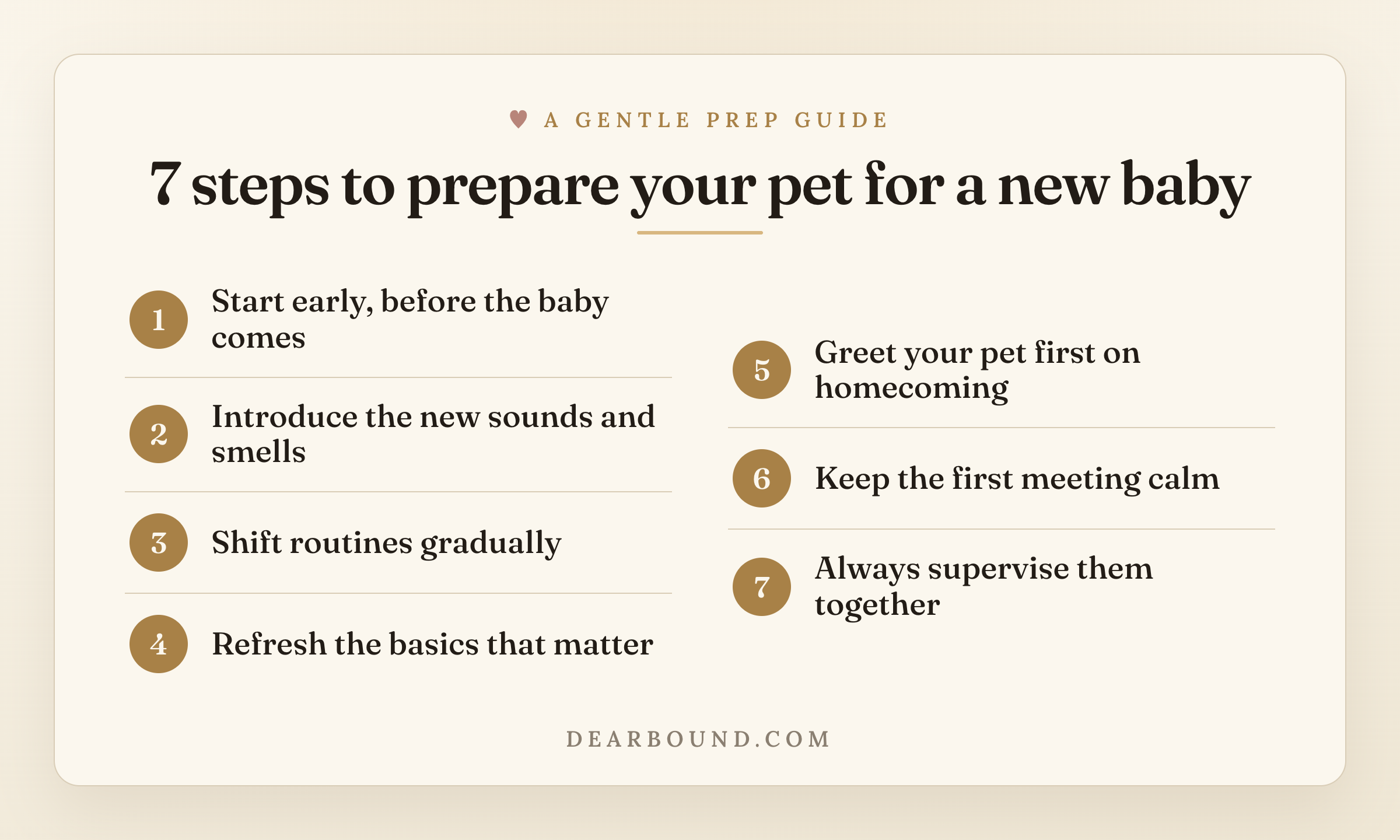
Start early — before the baby comes
This is the single most important idea in the whole guide, so it goes first: begin weeks or months ahead, not the day you come home from the hospital.
Pets are pattern-readers. If every change in the house arrives at the exact moment the baby does — new furniture, closed doors, a shift in your attention, less lap time — your pet quietly connects the dots. The baby is the thing that changed everything. That's the association you want to avoid.
So spread it out. Make the small changes now, gradually, while life is still calm and it's still just the two (or three) of you. By the time the baby actually arrives, most of the "new normal" will already feel normal — and none of it will feel like it showed up to displace them.
Get them used to the new sights, sounds, and smells
A newborn brings a lot of unfamiliar input into a home, and the more of it your pet has met before the big day, the less startling the real thing will be. The frame here is curiosity, not correction — you're introducing, not testing.
- The sounds. Baby cries are a genuinely new noise. Play recordings at a low volume during a nice, ordinary moment — while your pet eats, or gets a scratch — and let the sound just become part of the background. Slowly turn it up over days, never so loud it's distressing.
- The spaces. Let them investigate the nursery, sniff the crib, the changing table, the new furniture. A room that's been off-limits and mysterious is far more interesting (and stressful) than one they've already checked out at their own pace.
- The smell. If you can, let them sniff a blanket or a small item that carries the baby's scent before the two of them ever meet face to face. Scent is how a lot of animals "meet" someone. Doing it early takes the surprise out of the introduction.
Adjust routines gradually, not all at once
Be honest with yourself about what's going to change. Will walk times move? Will the dog no longer sleep on the bed? Will feeding shift by an hour? Whatever it is, start the change now, slowly, and well before the baby arrives — so the new schedule isn't something the baby "took away."
And a small trick that helps a lot: pair the changes with good things. If your pet is getting a little less lap time, add a new chew, a puzzle feeder, a fresh sniff-walk somewhere in the day. You want the season around the baby's arrival to come with new nice things attached, not just losses.
Refresh the basics that will matter
You don't need a perfectly trained pet — you need a few reliable habits that make the first weeks easier. A calm "settle" on a mat, a solid "leave it," a gentle greeting instead of a jump. A short refresher on these now pays off enormously when your arms are full and your patience is thin.
Keep it low-key and kind. This isn't boot camp; it's just topping up the things you already do together.
One honest note: some pets sail through this and some genuinely benefit from an extra hand. If your pet has a history of anxiety, guarding, or big reactions, it's worth looping in a professional trainer or asking your vet about a behavior consult — sooner rather than later, so you've got a plan before the baby's home. That's a general pointer, not a diagnosis. You know your animal best; a good trainer just gives you more tools.
The first introduction — keep it calm and low-pressure
The homecoming is the moment everyone worries about, and the whole thing goes better when you take the pressure off it.
- Greet the pet first. If you've been at the hospital, your pet has missed you — and they may be a little wound up. Let someone else hold the baby for a minute while you say a real hello. Get the excited reunion out of the way before the baby is in the picture.
- Keep it short and calm. The first meeting doesn't need to be a big event. A brief, quiet, low-key introduction is perfect. There's no prize for rushing it.
- Let them approach. Don't push your pet's face toward the baby or force contact. Let them come at their own speed, sniff if they want to, and back off if they want to. On their terms, they stay relaxed.
- Never make the baby a punishment. No banishing the pet to another room the second they walk in, no scolding them near the baby, no cold shoulder. If the baby's presence always means the pet gets shut out or told off, that's exactly the "replaced" feeling you're trying to prevent. Instead, praise calm curiosity — quietly reward the pet for being gently interested.
Never leave them unsupervised together
This is the one firm line in an otherwise gentle guide, and it isn't up for negotiation: no matter how gentle and trustworthy your pet is, an infant and a pet are never left alone together. Not for a minute, not "just while I grab the door." Supervise every single interaction. This isn't about distrusting your animal — it's simply the standard, and it stays in place for a long while. A calm adult in the room makes every early interaction safer for both of them.
Keep including them
Here's the heart of it. The goal was never just to get your pet to tolerate the baby. It's to make sure that, through all of this, your pet still feels like family.
So keep the things that made them feel like yours. Keep some one-on-one time, even if it's shorter — a walk that's just theirs, ten minutes of undivided attention after the baby goes down. Keep their spots and their rituals. And narrate the baby to them, out loud, the way you'd introduce any new family member: this is your new little human. You're the big one. You were here first.
Because that's the truth your pet needs to feel, more than anything you can train: the family got bigger, and there's still room for them.
If you want a warm way to say exactly that — to mark the change gently, from your pet's side of it — that's the idea behind Your Pet and the New Baby. It's a personalized, illustrated storybook that frames your pet as the original first family member and the baby's big sibling, telling them, in a story, the thing you most want them to know: you are not being replaced; our family is growing, and there's room for everyone. It works whether you're still expecting or the baby's already here.
Every page is painted from a single photo of your actual pet — so the animal in the book looks like yours, with their real markings and their real face, not a generic breed pick — and then finished by hand. It arrives as a digital, print-ready PDF, lovingly hand-finished within 24–48 hours, and it's $27. Read it aloud to your pet before the baby comes, or keep it as the first chapter of your growing family's story. (If your pet came to you on a memorable day, you might also like our Gotcha Day ideas — a nice companion for the pet who once "came home" and is now becoming a big sibling.)
Give it time
The first days can be clumsy. Your pet might be a little clingy, a little confused, a little put out — and that's not a failure, it's just an animal adjusting to the biggest change their small world has ever had. Most pets settle into being a big sibling within a few weeks, especially when the change was handled gently and they were never made to feel like the newcomer stole their place.
Patience, not perfection. You don't have to get every moment right. You just have to keep showing your pet, in a hundred small ways, that they still belong — that the family didn't get smaller when it got a new member.
Because it didn't. It grew. And your pet, the one who was your first, gets to be part of the whole rest of the story.